
Non-potable Bitters
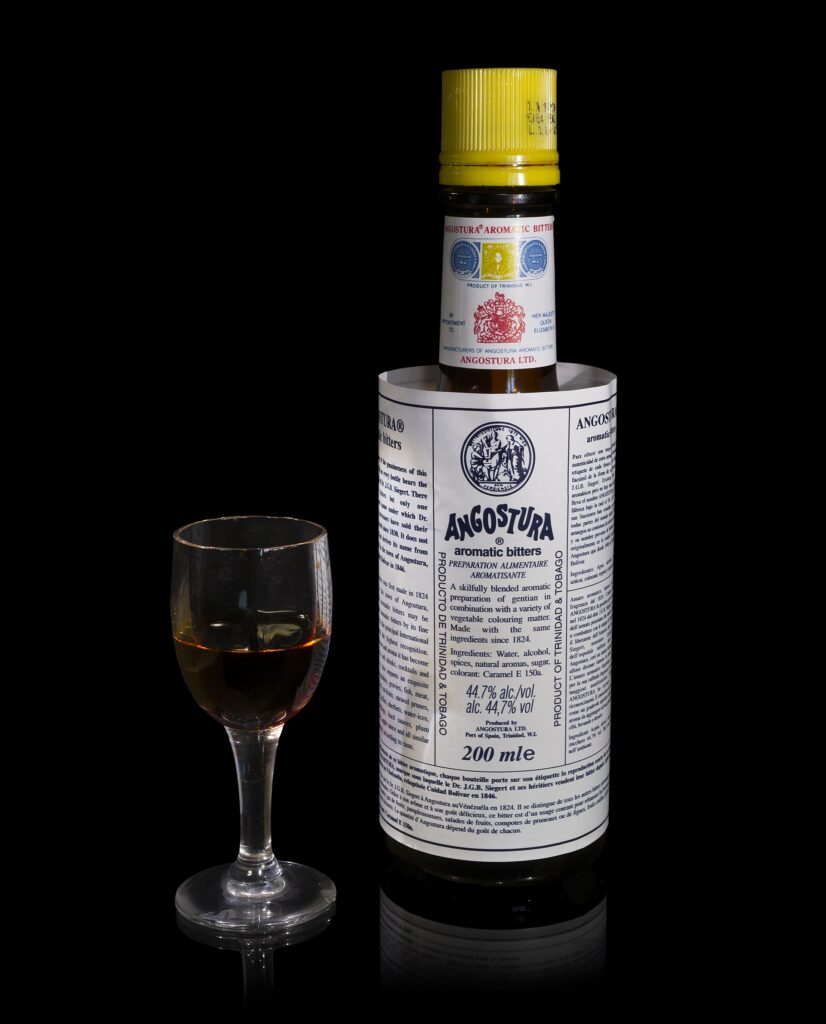
A concentrated flavouring ingredient intended to season drinks, commonly with strong bitterness and highly expressive botanical aromas. Quality lies in its contribution at an appropriate recipe dose, not in ease of drinking undiluted. Citrus, spice, herbs, roots, flowers or cacao may define individual products.
Color
Maturation
Alcohol
Sweetness
Balance
History
Non-potable bitters developed from concentrated preparations associated with medicinal use into small-dose cocktail ingredients. Angostura’s chronology dates Johann Siegert’s formulation to 1824 in Venezuela and the business’s move to Trinidad to 1875. That sequence provides a documented example of the transition into an international commercial product. It should not be used to credit one producer with every bitters recipe or to carry historical medicinal claims into modern training. Angostura: company chronology.
Classic characteristics
Appearance
Pale through intensely coloured, often amber or brown; clarity depends on extraction and filtration.
Aroma
Usually pronounced botanical concentration; identify the stated citrus, spice, herb or other lead flavour.
Flavor
Intensely bitter or otherwise concentrated; evaluate in a documented dilution or cocktail application.
Sweetness
Variable; sugar or glycerin can add sweetness without removing a strong bitter impression.
Mouthfeel
Thin to viscous as supplied; contribution at use concentration is more relevant than neat body.
Finish
Often long and bitter; persistence should season the recipe without overwhelming it.
Flavor Profile Deep Dive
Judge a recorded dose in a defined carrier; excessive bitterness in an undiluted sip is not a meaningful quality test. Assess stale or unbalanced character only at the agreed dose. Bitterness and high aroma concentration are expected; an undiluted sample is not the reference serving.
Service notes
Compare equal documented quantities in the same neutral test drink, then examine one relevant cocktail application. Keep an untreated control to show the change. Staff should never promise that a drink containing alcoholic bitters has absolutely no alcohol. Separate culinary flavour descriptions from unsupported digestive or medicinal claims, even when such language appears in historical marketing.
Style parameters
| Parameter | Boundary or expectation |
|---|---|
| Base material | Bittering botanicals and alcohol or glycerin carrier |
| Bottled strength | Product-specific, potentially substantial; nonbeverage status does not mean alcohol-free. |
| Color and clarity | Pale through intensely coloured, often amber or brown; clarity depends on extraction and filtration. |
| Maturation | No common requirement; extraction and resting are distinct from mandatory barrel maturation. |
| Additions | Bittering botanicals, aromatic ingredients and carrier; consult the actual formula or label for other materials. |
Legal limits apply only to the named jurisdiction and identity. ADI entry conditions and typical sensory expectations are separate; a product example is not a universal range.
Cocktail connections
Browse published cocktails. Documented recipes, conditional style choices and development substitutions are labeled separately.
- Alaska — documented; seasoning.
- Añejo Highball — documented; seasoning.
- Bamboo — documented; seasoning.
- Bijou — documented; seasoning.
- Brandy Crusta — documented; seasoning.
- Calvados Cocktail — documented; seasoning.
- Casino — documented; seasoning.
- Champagne Cocktail — documented; seasoning.
- Champs Elysées — documented; seasoning.
- De La Louisiane — documented; seasoning.
- Ford — documented; seasoning.
- Godfather — Irish whiskey version — documented variant; seasoning.
- Horse’s Neck — documented; seasoning.
- Japanese — documented; seasoning.
- Lion's Tail — documented; seasoning.
- Manhattan — documented; seasoning.
- Martinez — documented; seasoning.
- Monte Carlo — documented; seasoning.
- Oaxaca Old Fashioned — documented; seasoning.
- Old Cuban — documented; seasoning.
- Old Fashioned — documented; seasoning.
- Pegu Club — documented; seasoning.
- Pink Gin — documented; seasoning.
- Pisco Sour — documented; seasoning.
- Piscola — documented; seasoning.
- Queen’s Park Swizzle — documented; seasoning.
- Revolver — documented; seasoning.
- Rob Roy — documented; seasoning.
- Rosita — documented; seasoning.
- Sazerac — documented; seasoning.
- Scofflaw — documented; seasoning.
- Screwdriver — Difford version — documented; seasoning.
- Seelbach — documented; seasoning.
- Singapore Sling — documented; seasoning.
- Suffering Bastard — documented; seasoning.
- Three Dots And A Dash — documented; seasoning.
- Tipperary — documented; seasoning.
- Trident — documented; seasoning.
- Trinidad Sour — documented; base.
- Tuxedo — documented; seasoning.
- Vieux Carré — documented; seasoning.
- Weeski — documented; seasoning.
- Widow's Kiss — documented; seasoning.
- Zombie — documented; seasoning.
Style comparison
Cocktail bitters function more like seasoning than a base spirit or liqueur. Their bitterness should be assessed alongside aroma and concentration, not treated as a quality score by itself. A strongly bitter but aromatically dull product may be less useful than one with precise, integrated flavour. Different dispensing bottles can also produce different practical results.
Related styles: Herbal / Botanical / Spiced Liqueur · 0 ABV Mixer.
Ingredients
Bittering botanicals and alcohol or glycerin carrier
Production notes
ADI describes extraction of botanicals and bittering agents with alcohol or glycerin, for cocktail use rather than straight consumption. “Non-potable” here describes intended nonbeverage character; it does not mean that the ingredient is unsuitable for its proper culinary use. In the United States, nonbeverage status involves formulation assessment rather than the word bitters alone. A drinkable bitter liqueur belongs to a different category even if its label also says bitters.
Commercial examples
No newly verified benchmark is designated in this revision. The original example discussion below remains a research lead, with its original qualifications.
Retained example and source context. Angostura Aromatic Bitters illustrates concentrated herbal, fruit and spice seasoning. TTB nonbeverage formulation guidance. ADI scope: S082.
Photo credit
Angostura aromatic bitters. Photo: Didier Descouens / Wikimedia Commons. CC BY-SA 3.0. Display resized; no other edits.
