
Commercial Examples
Guinness Extra Stout (US version), O'Hara's Leann Folláin, Sheaf Stout

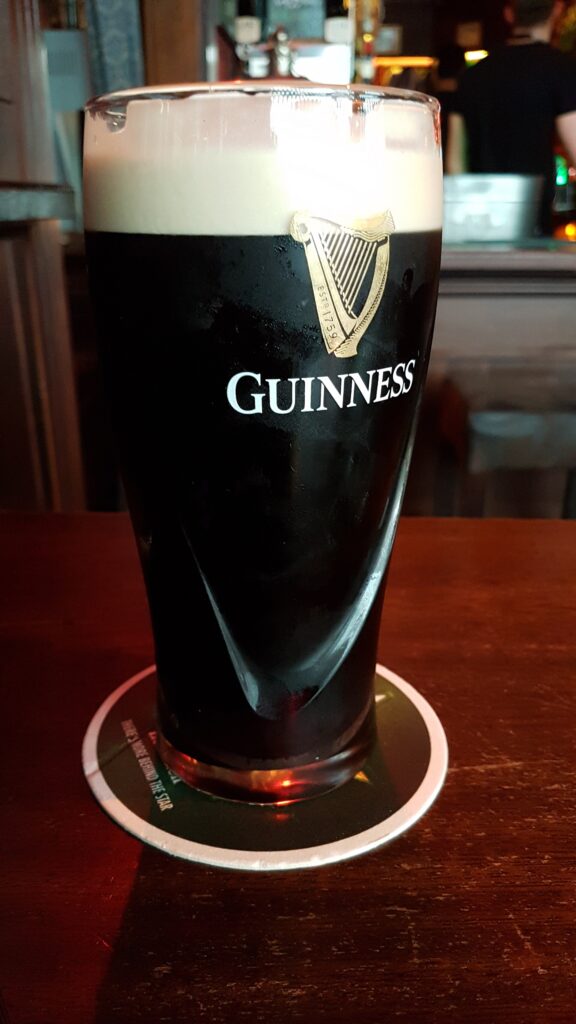
Where does the inspiration for new beer come from? The same question has been asked in every field in which creativity is a major part. Creators in beer do the same as artists in other fields—they copy things we already know, then make variations on it. The Irish Extra Stout is a perfect example. When Arthur Guinness II wrote a recipe to brew his Superior Porter in 1821, he set the stage for the next 200 years of Guinness's beer production. Over the span of the next five decades, Guinness became so popular that they were the largest brewery on the planet in 1873.
Extra Stout wouldn't have been possible without a new invention patented in 1818 by Daniel Wheeler. After watching coffee roasting techniques, he invented a rotating drum that could be used to create very dark malt that never came in direct contact with the flames that heated it. The result was what we still call "Black Patent" malt today, and it allowed brewers significantly more latitude in creating their darker brews.
This style originated in Dublin, Ireland, developed from the English Porter traditions but enhanced with stronger character and higher ABV than the standard Irish Stout.
Resulting partially from the new possibilities that the roasting drum gave brewers, the Irish Extra Stout is a variation on the Irish Stout's theme. Still based on that original 1821 process and recipe, this beer is bigger in ABV and flavor, particularly in the roasted grain category. It's less often served on nitro than the standard Irish Stout, so in many ways this style packs a little more punch than the Dry Stout.
Jet black. Opaque. A thick, creamy, tan head is characteristic.
Moderate to moderately high coffee-like aroma, often with slight dark chocolate, cocoa, biscuit, vanilla and/or roasted grain secondary notes. Esters medium-low to none. Hop aroma low to none, may be lightly earthy or spicy, but is typically absent. Malt and roast dominate the aroma.
Moderate to moderately high dark-roasted grain or malt flavor with a medium to medium-high hop bitterness. Moderate to moderately high coffee-like flavors with a dark chocolate character in the palate, lasting into the finish. Background mocha, biscuit, or vanilla flavors are often present and add complexity. The finish can be dry and coffee-like to moderately balanced with up to moderate caramel or malty sweetness. Medium-low to no fruitiness. Medium to no hop flavor.
Coffee, chocolate, and roast characteristics. Dry, roasty, and coffee-like with pronounced roasted grain character. Deep malty sweetness balanced by roasted dryness.
Dark chocolate, cocoa, biscuit, vanilla, and roasted grain secondary notes. Medium-low to no fruitiness. The level of bitterness and roasted character varies, allowing for brewer interpretation.
Long, dry, coffee-like finish with lingering roasted grain character. Very little perceived bitterness despite moderate IBU levels, as the roasted character dominates.
Serve fresh in a pint glass at 44°F. Best enjoyed on its own or paired with rich, fatty dishes that benefit from its roasted character and bitterness.
Overall Impression: A fuller-bodied black beer with a pronounced roasted flavor, often similar to coffee and dark chocolate with some malty complexity. The balance can range from moderately bittersweet to bitter, with the more balanced versions having up to moderate malty richness and the bitter versions being quite dry.
Aroma: Moderate to moderately high coffee-like aroma, often with slight dark chocolate, cocoa, biscuit, vanilla and/or roasted grain secondary notes. Esters medium-low to none. Hop aroma low to none, may be lightly earthy or spicy, but is typically absent. Malt and roast dominate the aroma.
Appearance: Jet black. Opaque. A thick, creamy, tan head is characteristic.
Flavor: Moderate to moderately high dark-roasted grain or malt flavor with a medium to medium-high hop bitterness. The finish can be dry and coffee-like to moderately balanced with up to moderate caramel or malty sweetness. Typically has roasted coffee-like flavors, but also often has a dark chocolate character in the palate, lasting into the finish. Background mocha, biscuit, or vanilla flavors are often present and add complexity. Medium-low to no fruitiness. Medium to no hop flavor (often earthy or spicy). The level of bitterness is somewhat variable, as is the roasted character and the dryness of the finish; allow for interpretation by brewers.
Mouthfeel: Medium-full to full body, with a somewhat creamy character. Moderate carbonation. Very smooth. May have a light astringency from the roasted grains, although harshness is undesirable. A slightly warming character may be detected.
Comments: Traditionally a bottled product. Consumers expect a stout to always have a black color; the flavor intensity from whatever made it black is what consumers expect in their beer. Not all breweries make a dry, roasty version typical of Guinness; a more balanced and chocolaty version is equally acceptable.
History: Same roots as Irish stout, but as a stronger product. Guinness Extra Stout (Extra Superior Porter, later Double Stout) was first brewed in 1821, and was primarily a bottled product. Described by Guinness as a "more full-bodied beer with a deeper characteristic roasted bitterness and a rich, mature texture. Of all the types of Guinness available today, this is the closest to the porter originally brewed by Arthur Guinness." Note that in modern times, Guinness Extra Stout has different strengths in different regions; the European version is around 4.2% and fits in the Irish Stout style.
Characteristic Ingredients: Similar to Irish Stout.
Style Comparison: Midway between an Irish Stout and a Foreign Extra Stout in strength and flavor intensity, although with a similar balance. More body, richness, and often malt complexity than an Irish Stout. Black in color, not brown like a porter.
Vital Statistics: OG: 1.052 – 1.062 IBUs: 35 – 50 FG: 1.010 – 1.014 SRM: 25 – 40 ABV: 5.5 – 6.5%
Commercial Examples: Guinness Extra Stout (US version), O'Hara's Leann Follain, Sheaf Stout
Export-Style Stout Color: Black Clarity: Opaque Perceived Malt Aroma & Flavor: Coffee-like roasted barley and roasted malt aromas are prominent. Initial malt and light caramel flavors give way to a distinctive dry-roasted bitterness in the finish. Perceived Hop Aroma & Flavor: Should not be present Perceived Bitterness: May be analytically high, but the perception is lessened by malt sweetness. Fermentation Characteristics: Fruity esters are low. Diacetyl is usually absent in these beers but may be present at very low levels. Slight acidity is acceptable. Body: Medium to full Additional notes: Head retention should be persistent Original Gravity: 1.052-1.072 (12.9-17.5 Plato) Final Gravity: 1.008-1.020 (2.1-5.1 Plato) Alcohol by Weight (Volume): 4.5%-6.4% (5.6%-8.0%) Bitterness (IBU): 30-60 Color SRM (EBC): 40+ (80+ EBC)
Two-row brewers malt, roasted barley, flaked barley. Use roasted barley for a significant portion of the roasted grain percentage, which can be 10% or more for this style. The roasted barley gives this beer its characteristic dryness and roasted coffee character.
Neutral Irish ale yeast. Ferment with English yeast for a pomme fruit fermentation profile.
Soft to moderately sulfate water typical of Irish regions.
A single infusion mash is traditional. Plan to mash in the low-middle range for higher alcohol but not too light of a body (151-152°F).
Ferment cool to develop smooth, clean profile. Extended aging helps develop complexity.
At the Pub: Oyster night Takeout: Reubens Barbecue night: Low and slow smoked ribs
Aged cheddar, smoked gouda, Irish cheddar
Oyster night, low and slow smoked ribs, hearty stews, venison
Rich chocolate desserts, dark chocolate torte, mocha-flavored desserts
Black Flannel Vermont Common
New: Flogging Molly Old: Stravinsky, Le sacre du printemps
Guinness Extra Stout (US version), O'Hara's Leann Folláin, Sheaf Stout