
Commercial Examples
Guinness Draught, Guinness Extra Stout, Smithwick's Irish Ale (borderline style), Beamish Stout, Murphy's Irish Stout

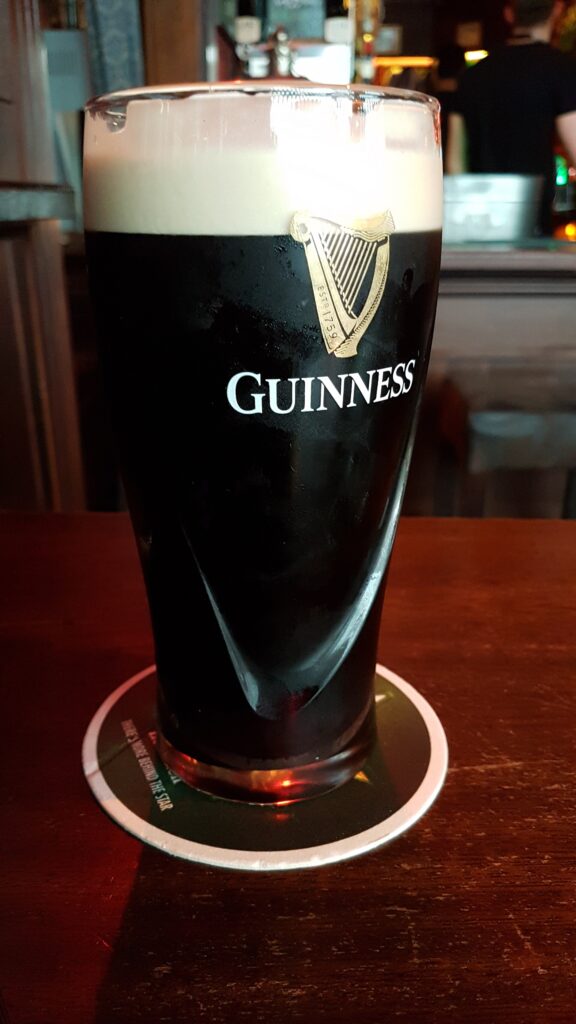
A dry, dark, roasty stout with a smooth, creamy palate and characteristic dry roasted coffee and grain character. Irish Stout is an invented style in many ways—its modern character was defined largely by one brewery (Guinness) beginning in 1759, and it has become the definitive stout style for millions of drinkers worldwide.
Irish Stout emerged from the broader English porter and stout tradition, but its modern identity was forged at St. James's Gate Brewery in Dublin by Arthur Guinness beginning in 1759. Guinness pioneered the use of roasted unmalted barley in stout, creating the characteristic dry roasted coffee and grain flavors that define the style. This innovation was partly economical—unmalted barley was cheaper than malted grain—but it fundamentally transformed the style and created a distinctive profile.
Guinness's dominance in the market and global reach meant that their interpretation of stout became the standard against which all Irish stouts are judged. The style is not ancient; rather, it is a relatively modern creation shaped by one brewery's innovations and marketing prowess. However, it has become so integral to Irish beer culture that it is now considered quintessentially Irish.
Irish Stout originated in Dublin, at St. James's Gate Brewery, home of Guinness. While stout tradition extends across Ireland and the British Isles, the Irish interpretation—defined by Guinness's approach—is what distinguishes Irish Stout from English Stout.
Today, Irish Stout remains dominated globally by Guinness, though other Irish breweries produce versions maintaining the characteristic dry roasted profile. The style has become synonymous with Irish identity and pub culture worldwide.
Opaque black to very dark brown, with a thick, persistent tan to beige head (crema). The head is a signature element of Irish Stout, particularly when served on nitrogen. Clear color distinction between head and beer body.
Roasted grain and roasted coffee aroma, dry and slightly acrid. Subtle chocolate notes. Very little malt sweetness aroma. Minimal hop aroma. Some alcohol warmth may be present.
Dry, roasted character with roasted coffee, roasted grain, and cocoa flavor. The key signature is dryness—despite moderate sweetness from the grain bill, the roasted unmalted barley contributes astringency and dryness that defines the style. Low bitterness balances the roasted character. Very smooth palate with minimal roughness despite the roasted intensity. Finish is dry with lingering roasted coffee and grain character.
Dry roasted coffee and grain character is paramount. The roasted unmalted barley creates an astringency and dryness that is signature to the style. Subtle underlying sweetness from the malt bill balances the roasted intensity.
Cocoa and subtle chocolate notes, subtle sweetness from residual carbohydrates, gentle alcohol warmth, minimal hop character.
Dry, smooth finish with lingering roasted coffee and grain character. No harsh or astringent aftertaste—the balance between roasted dryness and malt sweetness creates a smooth overall impression despite the intensity.
Serve at 50-55°F in a traditional pint glass. Nitrogen service (if available) creates the characteristic creamy head and smooth mouthfeel. The beer should be poured with patience—a proper Guinness pour takes time to settle and develop.
Overall Impression: A black beer with a pronounced roasted flavor, often similar to coffee. The balance can range from fairly even to quite bitter, with the more balanced versions having a little malty sweetness and the bitter versions being quite dry. Draught versions typically are creamy from a nitro pour, but bottled versions will not have this dispense-derived character. The roasted flavor can be dry and coffee-like to somewhat chocolaty.
Aroma: Moderate coffee-like aroma typically dominates; may have slight dark chocolate, cocoa and/or roasted grain secondary notes. Esters medium-low to none. Hop aroma low to none, may be lightly earthy or floral, but is typically absent.
Appearance: Jet black to very deep brown with garnet highlights in color. According to Guinness, "Guinness beer may appear black, but it is actually a very dark shade of ruby." Opaque. A thick, creamy, long-lasting, tan- to brown-colored head is characteristic when served on nitro, but don't expect the tight, creamy head on a bottled beer.
Flavor: Moderate roasted grain or malt flavor with a medium to high hop bitterness. The finish can be dry and coffee-like to moderately balanced with a touch of caramel or malty sweetness. Typically has coffee-like flavors, but also may have a bittersweet or unsweetened chocolate character in the palate, lasting into the finish. Balancing factors may include some creaminess, medium-low to no fruitiness, and medium to no hop flavor (often earthy). The level of bitterness is somewhat variable, as is the roasted character and the dryness of the finish; allow for interpretation by brewers.
Mouthfeel: Medium-light to medium-full body, with a somewhat creamy character (particularly when served with a nitro pour). Low to moderate carbonation. For the high hop bitterness and significant proportion of dark grains present, this beer is remarkably smooth. May have a light astringency from the roasted grains, although harshness is undesirable.
Comments: When a brewery offered a stout and a porter, the stout was always the stronger beer (it was originally called a "Stout Porter"). Modern versions are brewed from a lower OG and no longer necessarily reflect a higher strength than porters. This is typically a draught product today; bottled versions are typically brewed from a higher OG and are usually called Extra Stouts. Regional differences exist in Ireland, similar to variability in English Bitters. Dublin-type stouts use roasted barley, are more bitter, and are drier. Cork-type stouts are sweeter, less bitter, and have flavors from chocolate and specialty malts. Commercial examples of this style are almost always associated with a nitro pour.
History: The style evolved from attempts to capitalize on the success of London porters, but originally reflected a fuller, creamier, more "stout" body and strength. Guinness began brewing only porter in 1799, and a "stouter kind of porter" around 1810. Irish stout diverged from London single stout (or simply porter) in the late 1800s, with an emphasis on darker malts. Guinness was among the first breweries to use black patent malt for porters and stouts in the 1820s. Guinness began using roasted barley after WWII, while London brewers continued to use brown malt. Guinness started using flaked barley in the 1950s, also increasing attenuation greatly. Guinness Draught was launched as a brand in 1959. Draught cans and bottles were developed in the late 1980s and 1990s.
Characteristic Ingredients: Guinness is made using roasted barley, flaked barley, and pale malt, but other breweries don't necessarily use roasted barley; they can use chocolate or other dark and specialty malts. Whatever combination of malts or grains is used, the resulting product should be black. Cork-type stouts are perhaps closer to historical London-type stouts in composition with a varied grist not dominated by roasted barley.
Style Comparison: Lower strength than an Irish Extra Stout, but with similar flavors. Darker in color (black) than an English porter (brown).
Vital Statistics: OG: 1.036 – 1.044 IBUs: 25 – 45 FG: 1.007 – 1.011 SRM: 25 – 40 ABV: 4.0 – 4.5%
Commercial Examples: Beamish Irish Stout, Guinness Draught, Harpoon Boston Irish Stout, Murphy's Irish Stout, O'Hara's Irish Stout, Porterhouse Wrasslers 4X
Classic Irish-Style Dry Stout Color: Black Clarity: Opaque Perceived Malt Aroma & Flavor: The prominence of coffee-like roasted barley and a moderate degree of roasted malt aroma and flavor defines much of the character. The hallmark dry-roasted attributes typical of Dry Stout result from the use of roasted barley. Initial malt and light caramel flavors give way to a distinctive dry-roasted bitterness in the finish. Perceived Hop Aroma & Flavor: European hop character may range from not present to low in aroma and flavor Perceived Bitterness: Medium to medium-high Fermentation Characteristics: Fruity esters are low relative to malt and roasted barley as well as hop bitterness. Diacetyl is usually absent in these beers but may be present at very low levels. Slight acidity may be present but is not required. Body: Medium-light to medium Additional notes: Head retention should be persistent Original Gravity: 1.038-1.048 (9.5-11.9 Plato) Final Gravity: 1.008-1.012 (2.1-3.1 Plato) Alcohol by Weight (Volume): 3.2%-4.2% (4.1%-5.3%) Bitterness (IBU): 30-40 Color SRM (EBC): 40+ (80+ EBC)
Pale malts (Pale Ale or Pilsner) as base (70-75%), with roasted unmalted barley (10-15%) for characteristic roasted coffee and dry character. Small amounts of flaked barley (5%) for smoothness and nitrogen retention. Some caramel malt (5-10L) for subtle sweetness.
Irish hop varieties or other traditional varieties at modest levels for bittering. Low alpha acids. Minimal aromatic hops. Balance is key—hops should not dominate.
English ale yeast, preferably one that produces clean fermentation with minimal ester production.
Soft to moderately sulfate water. The water chemistry creates the smooth, clean character.
Single infusion mash in the low saccharification range (148-152°F) to retain some residual sweetness that balances the roasted dryness.
Moderate ale fermentation temperatures (62-68°F) for 7-14 days. Proper conditioning is important for smooth palate.
At the Pub: Oyster night Takeout: Reubens Barbecue night: Low and slow smoked ribs
Irish cheddar, aged Irish farmhouse cheeses, sharp provolone
Roasted oysters, smoked fish, corned beef, Irish stew, roasted lamb, game meats
Dark chocolate desserts, chocolate truffles, coffee-based desserts, bitter chocolate fare
Traditionally paired with Irish cuisine, pub fare, and seafood; excellent as an aperitif or with meals.
Black Flannel Vermont Common
New: Dropkick Murphys Old (but not really): Donnacha Dennehy, Gras abus Bas
Guinness Draught, Guinness Extra Stout, Smithwick's Irish Ale (borderline style), Beamish Stout, Murphy's Irish Stout