
American Porter
A substantial, malty dark beer with a complex and flavorful dark malt character.
—## Brewing History & Origins
Historical Development
The origins of imperial stout are tied tightly to the history of porter in eighteenth-century England (think decorative lights in National Lampoon's Christmas Vacation tight). You can see our post on porter for a bit more info on how that beer became so popular, but once it was the hot commodity in northern Europe, the bigger commercial breweries in London began brewing an imperial version for export to the Baltic region (Lithuania, Latvia, and Estonia) and Russia.
Exported versions of any style were often brewed with significantly higher hopping rates (10 lb/bbl in the early imperial stouts for you hop heads out there!) and a higher alcohol content for their long journey to those countries. There is now some discussion among beer writers as to whether styles like this, including IPA, evolved as a purely practical matter–they needed the alcohol and bitter hop acids to combat infection–or if other factors were at play. Whatever the case, the story goes that the Russian court, and specifically Catherine the Great, loved the style. We don't blame her…this stuff will warm your soul, and we need all the help we can get for about eleven months each year in northern Vermont.
Imperial stout helped break the trend of flavorless canned fizzy water here in the states (respect) when Merchant du Vin asked the folks at England's Samuel Smith Brewery to make an imperial stout for the American market. Craft producers became interested in brewing it, and American consumers obliged. Although it might be hard to imagine, the style as we know it today is relatively young and evolving quickly. American brewers have done just about anything you could imagine to imperial stouts, including aging them on fruit and spices, brewing them with hot peppers and sauces, and aging them in spirit and wine barrels (these are some of our favorite versions here in the brewery). Over the past several years, a new trend of culinary-inspired imperial stouts have exploded in the craft beer world, including beers that taste like s'mores, black forest cake, vanilla truffles, and cinnamon rolls to name a few.
Imperial stout is a beer that requires patience. Patience on brew day, patience as it conditions to perfection, patience when you open a bottle and sip it by the fire, and, if you're able, patience to age a few of them for several years and see how they change.### Geographic Origin
Modern Evolution
A style with a long, although not necessarily continuous, heritage. Traces roots to strong English porters brewed for export in the 1700s, and said to have been popular with the Russian Imperial Court. After the Napoleonic wars interrupted trade, these beers were increasingly sold in England. The style eventually all but died out, until being popularly embraced in the modern craft beer era, both in England as a revival and in the United States as a reinterpretation or re-imagination by extending the style with American characteristics.## Style Profile
Appearance
Deep, opaque, black. A few English examples can be very deep brown.### Aroma
Chocolate (dark or milk), coffee, roast
Large variety of possible hop characters including citrus, pine, and fruit from American examples or earthy, herbal, and floral for European examples.
Large variety of possible yeast characters ranging from clean to very fruity### Flavor
Ranges from fairly sweet to quite bitter. Bitterness usually comes from a complex interaction between roasted malts and hops.### Mouthfeel
Thick, mouth-coating body with medium-low carbonation. Younger examples can often have some astringency, but this dissipates with some age.## Technical Specifications
Original Gravity (OG)
Range: 1.075 – 1.115
Final Gravity (FG)
Range: 1.018 – 1.030
Alcohol by Volume (ABV)
Range: 8.0 – 12.0%
International Bittering Units (IBU)
Range: 50 – 90
Standard Reference Method (SRM)
Range: 30 – 40
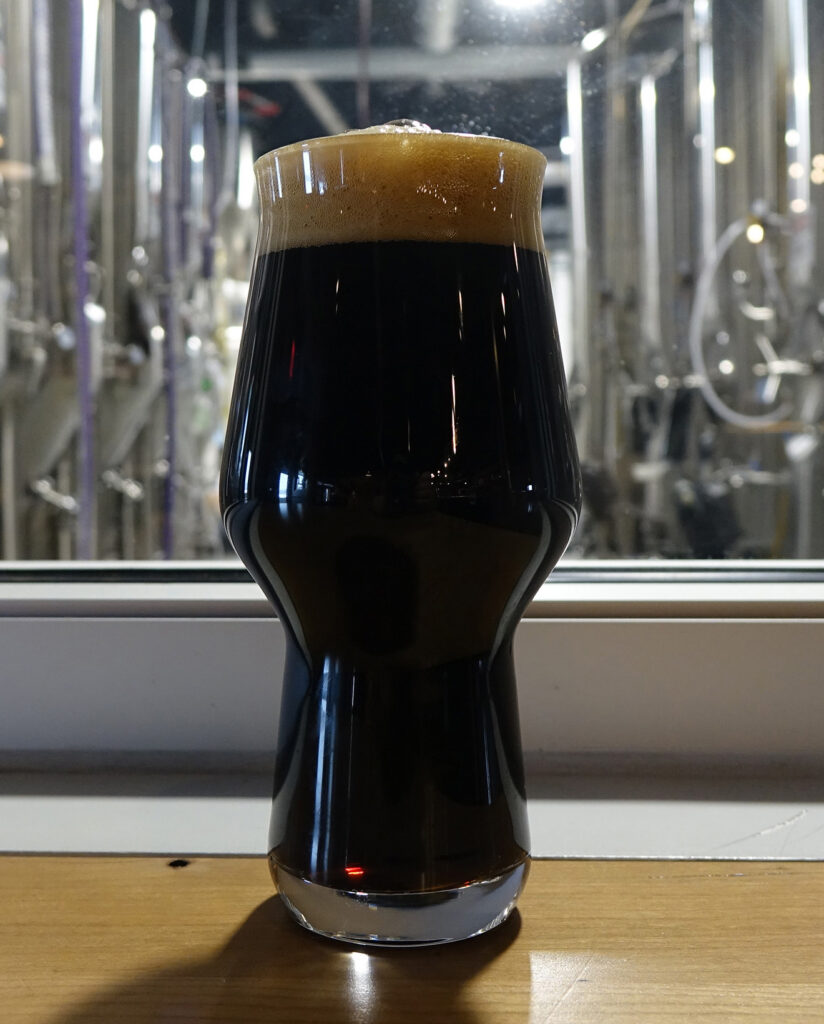
A fairly strong, highly roasted, bitter, hoppy dark stout. Has the body and dark flavors typical of stouts with a more aggressive American hop character and bitterness.