
Scottish Single Malt Whisky
A malted-barley Scotch from one distillery, with an exceptionally broad sensory range: fresh fruit, flowers, cereal, nuts, dried fruit, oak, smoke and savoury notes in varying combinations. The style is unified by production and origin, not by universal peat intensity or a single regional flavour map.
Color
Maturation
Alcohol
Sweetness
Balance
History
Scottish single malt’s modern international profile was strengthened by Glenfiddich’s deliberate promotion of its single malt outside Scotland in 1963. The producer’s retrospective identifies that campaign as a major commercial turning point. It should not be inflated into a claim that no single malt had previously been bottled or sold. The milestone concerns wider marketing of a distillery’s identity within an already established malt-distilling tradition. William Grant & Sons: retrospective on the 1963 single-malt launch.
Classic characteristics
Appearance
Pale gold through deep amber; casks and permitted colouring prevent reliable age estimation by sight.
Aroma
Medium to pronounced malt and fermentation fruit, with flowers, nuts, oak, dried fruit or smoke as appropriate.
Flavor
Distillery and cask character in balance; unpeated, lightly smoky and intensely peated expressions are legitimate.
Sweetness
Dry with sweet-associated malt, fruit and wood aromas; SC excludes sweetening.
Mouthfeel
Light and silky through oily and full; alcohol warmth and wood grip vary.
Finish
Medium to long in many expressions; assess the quality of persistence rather than length alone.
Flavor Profile Deep Dive
Assess the actual malt/cask/peat choices; region and age do not prescribe one mandatory sensory profile. Investigate persistent solvent-like pungency, unpleasant stale character or wood astringency that overwhelms the intended expression. A descriptor alone cannot prove a distillation-cut error, additive use or chemical safety.
Service notes
Build an introductory flight around actual flavour contrasts: unpeated fruit-led, richer cask-led and peated. Record strength and maturation so tasters understand the comparison's limits. Describe smoke specifically when possible—woodsmoke, ash or medicinal impressions—without forcing all of them into every note. For consumers, start with flavour preference and desired intensity, then use region and distillery history to add useful context.
Style parameters
| Parameter | Boundary or expectation |
|---|---|
| Base material | Malted barley |
| Bottled strength | SC applies; stronger releases can change substantially with measured dilution. |
| Scotland: bottled ABV | at least 40%; see identity requirements. |
| United States: bottled ABV | at least 40%; Whiskey identity; protected origin and named types have additional rules. |
| Color and clarity | Pale gold through deep amber; casks and permitted colouring prevent reliable age estimation by sight. |
| Maturation | SC applies; an age statement reflects the youngest qualifying whisky in the bottle. |
| Additions | SC applies; natural-colour and filtration claims need separate producer confirmation. |
Legal limits apply only to the named jurisdiction and identity. ADI entry conditions and typical sensory expectations are separate; a product example is not a universal range.
Cocktail connections
Style comparison
Single malt means one distillery, not one barrel, one vintage or one barley field. It differs from blended malt through origin of the malt components and from single grain through production requirements. Islay need not always mean heavily peated, and Speyside need not always mean unpeated or sweet. Those shortcuts can be starting hypotheses, not judging rules.
Related styles: Scottish Blended Malt Whisky · Irish Single Malt Whiskey.
Ingredients
Malted barley
Production notes
the Scotch specification supplies the single-malt and common Scotch requirements. Fermentation, still shape and operation, spirit selection and maturation all shape the result. Many casks and batches may be combined while retaining single-malt identity. Peated malt is optional, and cask strength, single cask and age statement are separate descriptors. The producer's region provides useful context but does not replace evidence about the bottle's actual production and flavour.
Commercial examples
No newly verified benchmark is designated in this revision. The original example discussion below remains a research lead, with its original qualifications.
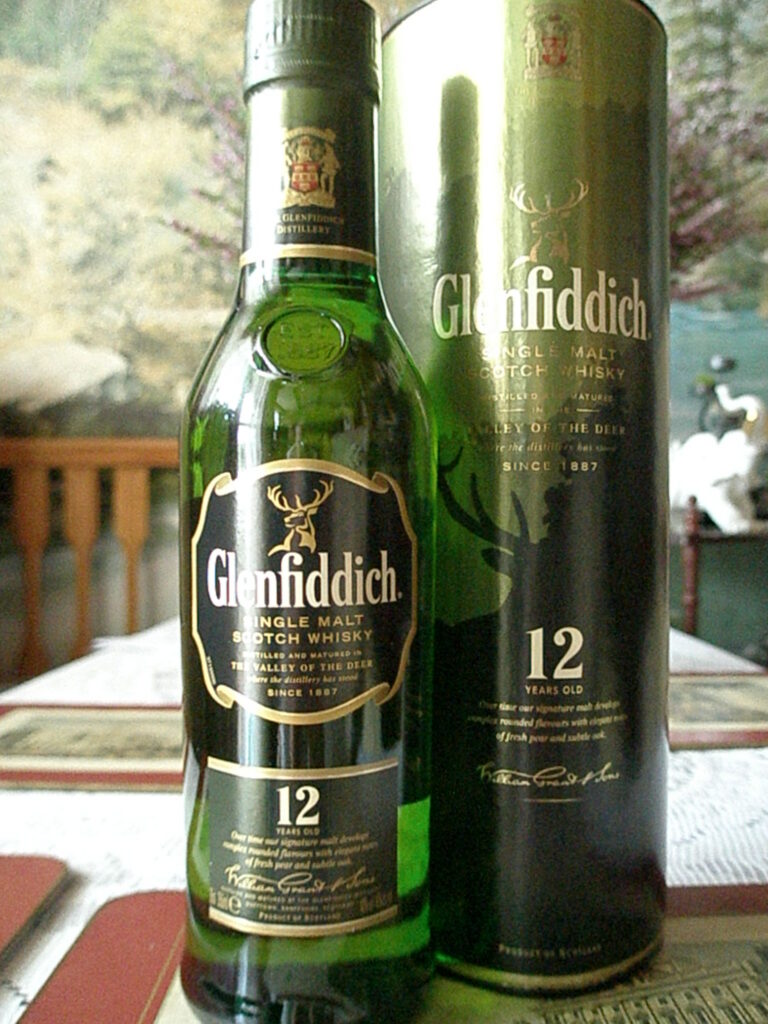
Retained example and source context. Glenfiddich 12 Year Old producer tasting reference illustrates a fruit-led expression. ADI scope: S126; the Scotch specification.
Photo credit
Glenfiddich 12 Year Old single malt Scotch whisky. Photo: Blueye / Wikimedia Commons. CC BY-SA 3.0. Display resized; no other edits.

Keep exploring
- Scotch Whisky product specification — evidence reviewed 2026-09-17.
- 27 CFR 5.143 — evidence reviewed 2026-09-18.