
Scottish Blended Malt Whisky
A Scotch made entirely from malt whiskies associated with more than one distillery, combining their fruit, cereal, wood and optional smoke characteristics. It can be bright and approachable or deeply smoky and concentrated. The category offers a blender's malt-based composition rather than one obligatory flavour profile.
Color
Maturation
Alcohol
Sweetness
Balance
History
Scottish Blended Malt Whisky’s modern identity was clarified by the Scotch Whisky Regulations of 2009, which formalized category terminology. The legal name helped distinguish blends composed of malt whiskies from blends also containing grain whisky. That is a naming and classification milestone, not the invention of blending malts. Earlier bottles and historical writing may use different terminology, which should be interpreted in its own period. Scotch Whisky Association: historical chronology.
Classic characteristics
Appearance
Pale gold to deep amber; wood and permitted colour adjustment affect shade.
Aroma
Medium to pronounced malt, fruit, vanilla, nuts or spice; smoke depends on selected components.
Flavor
An integrated malt-led composition; fruity, sherried, smoky or other directions are all possible.
Sweetness
Dry with sweet-associated malt, fruit and oak impressions; no added sweetening under SC.
Mouthfeel
Medium to full, sometimes silky or oily; tannin and alcohol should suit the intended concentration.
Finish
Medium to long in many examples; coherence matters more than a predetermined duration.
Flavor Profile Deep Dive
Assess malt-blend integration; absence of grain whisky is a composition fact rather than an automatic quality advantage. Investigate persistent solvent-like pungency, unpleasant stale character or wood astringency that overwhelms the intended expression. A descriptor alone cannot prove a distillation-cut error, additive use or chemical safety.
Service notes
Compare a fruit-led and a smoke-led example to demonstrate the category's breadth. If components are disclosed, taste them separately as an optional exercise without expecting the blend to be a simple arithmetic average of their flavours. In service, describe malt, fruit, wood and smoke levels before discussing blend status. Do not promise that “all malt” means heavier, older or better than every malt-and-grain Scotch.
Style parameters
| Parameter | Boundary or expectation |
|---|---|
| Base material | Fermented grain mash; identify grain and component types |
| Bottled strength | SC applies; record exact strength before comparing standard and cask-strength releases. |
| Scotland: bottled ABV | at least 40%; see identity requirements. |
| United States: bottled ABV | at least 40%; Whiskey identity; protected origin and named types have additional rules. |
| Color and clarity | Pale gold to deep amber; wood and permitted colour adjustment affect shade. |
| Maturation | SC applies to the qualifying whisky; an age claim concerns the youngest component. |
| Additions | SC applies; do not confuse permitted colour adjustment with flavouring or neutral-spirit blending. |
Legal limits apply only to the named jurisdiction and identity. ADI entry conditions and typical sensory expectations are separate; a product example is not a universal range.
Cocktail connections
Style comparison
Blended malt differs from blended Scotch by excluding grain whisky from the blend. It differs from single malt through distillery origin, not because the latter necessarily comes from one barrel. Older terms such as vatted malt can appear in historical discussion, but current label terminology should lead staff communication. A blended malt need not reveal each source distillery to be sensorially coherent.
Related styles: Scottish Blended Whisky · Scottish Single Malt Whisky.
Ingredients
Fermented grain mash; identify grain and component types
Production notes
the Scotch specification defines the legal category conventionally labelled “Blended Malt Scotch Whisky.” The supplied ADI heading uses Scottish rather than Scotch; this guide preserves the mapping while explaining the legal terminology. Components can vary by distillery, age and cask treatment. The absence of grain whisky in this category does not mean a single barrel or a single distillery, and it does not establish a quality advantage over a balanced malt-and-grain blend.
Commercial examples
No newly verified benchmark is designated in this revision. The original example discussion below remains a research lead, with its original qualifications.
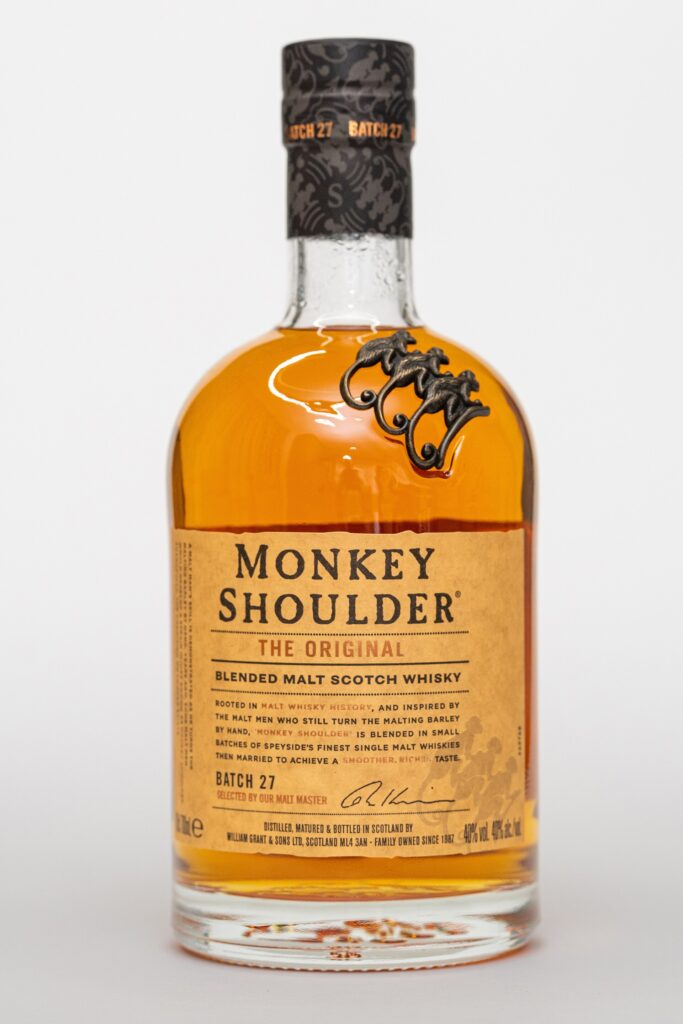
Retained example and source context. Monkey Shoulder Original documents its use of Speyside single malts. ADI scope: S123; the Scotch specification.
Photo credit
Monkey Shoulder blended malt Scotch whisky. Photo: DYVER / Wikimedia Commons. CC BY-SA 4.0. Display resized; no other edits.

Keep exploring
- Scotch Whisky product specification — evidence reviewed 2026-09-17.
- 27 CFR 5.143 — evidence reviewed 2026-09-18.