
Scottish Blended Whisky
A Scotch composition combining malt and grain whiskies, potentially ranging from gentle cereal and fruit to substantial smoke, dried fruit and mature oak. The blend should have a clear intended balance and a coherent finish. Familiarity and consistency can be deliberate strengths without excluding complexity.
Color
Maturation
Alcohol
Sweetness
Balance
History
Blended Scotch developed with nineteenth-century changes in distilling and the commercial work of blenders and merchants. Grain-whisky production made different components available for combination with malt whisky, helping businesses build consistent branded products. The Scotch Whisky Association’s chronology places blending within this broader industrial expansion. It is better understood as a developing trade than as a single recipe invented simultaneously by the whole industry. Scotch Whisky Association: historical chronology.
Classic characteristics
Appearance
Pale gold to deep amber; cask selection and permitted colour adjustment can both contribute.
Aroma
Light to pronounced grain, malt, fruit, vanilla, spice and optional smoke.
Flavor
Integrated malt and grain character, with casks and peat providing variable depth or contrast.
Sweetness
Dry with sweet-associated aromas; no sweetening under SC, despite caramel or honey descriptors.
Mouthfeel
Light and silky to rich and rounded; grain whisky does not force one texture.
Finish
Short to long, with proportionate fruit, wood, cereal or smoke persistence.
Flavor Profile Deep Dive
Judge coherence of malt and grain components; malt percentage cannot be reliably inferred from intensity alone. Investigate persistent solvent-like pungency, unpleasant stale character or wood astringency that overwhelms the intended expression. A descriptor alone cannot prove a distillation-cut error, additive use or chemical safety.
Service notes
Compare two blends with different declared flavour aims, then assess one in a simple highball. Note which aromas persist and whether dilution exposes grain, fruit or smoke. Avoid equating a smoother impression with lower quality or a higher malt percentage with automatic superiority. Restaurant descriptions should make the guest's choice easier: light and fruity, richer and oaky, or distinctly smoky, when the tasted bottle supports those terms.
Style parameters
| Parameter | Boundary or expectation |
|---|---|
| Base material | Fermented grain mash; identify grain and component types |
| Bottled strength | SC applies; stronger releases require comparison at a controlled tasting strength. |
| Scotland: bottled ABV | at least 40%; see identity requirements. |
| United States: bottled ABV | at least 40%; Whiskey identity; protected origin and named types have additional rules. |
| Color and clarity | Pale gold to deep amber; cask selection and permitted colour adjustment can both contribute. |
| Maturation | SC applies; a stated age refers to the youngest whisky in the blend. |
| Additions | SC applies; added neutral alcohol is not part of this identity. |
Legal limits apply only to the named jurisdiction and identity. ADI entry conditions and typical sensory expectations are separate; a product example is not a universal range.
Cocktail connections
Style comparison
Blended malt contains only malt components, whereas this category includes grain whisky. A single-malt bottling may also combine many casks, so “blended” should not be taught merely as mixing liquids. An age-stated blend is not an average of component ages. Smoke can be central, subtle or absent; a Scottish origin does not oblige a medicinal or peaty flavour.
Related styles: Scottish Blended Malt Whisky · Scottish Grain Whisky.
Ingredients
Fermented grain mash; identify grain and component types
Production notes
The legal designation is “Blended Scotch Whisky”; the Scotch specification gives the component distinction and shared origin rules. Producers select whiskies of differing character and cask history to build a recognizable expression. The term does not permit the neutral-spirit blending associated with ordinary U.S. blended whiskey. Nor does it prescribe a fixed malt proportion, number of distilleries or sensory intensity for all products in the category.
Commercial examples
No newly verified benchmark is designated in this revision. The original example discussion below remains a research lead, with its original qualifications.
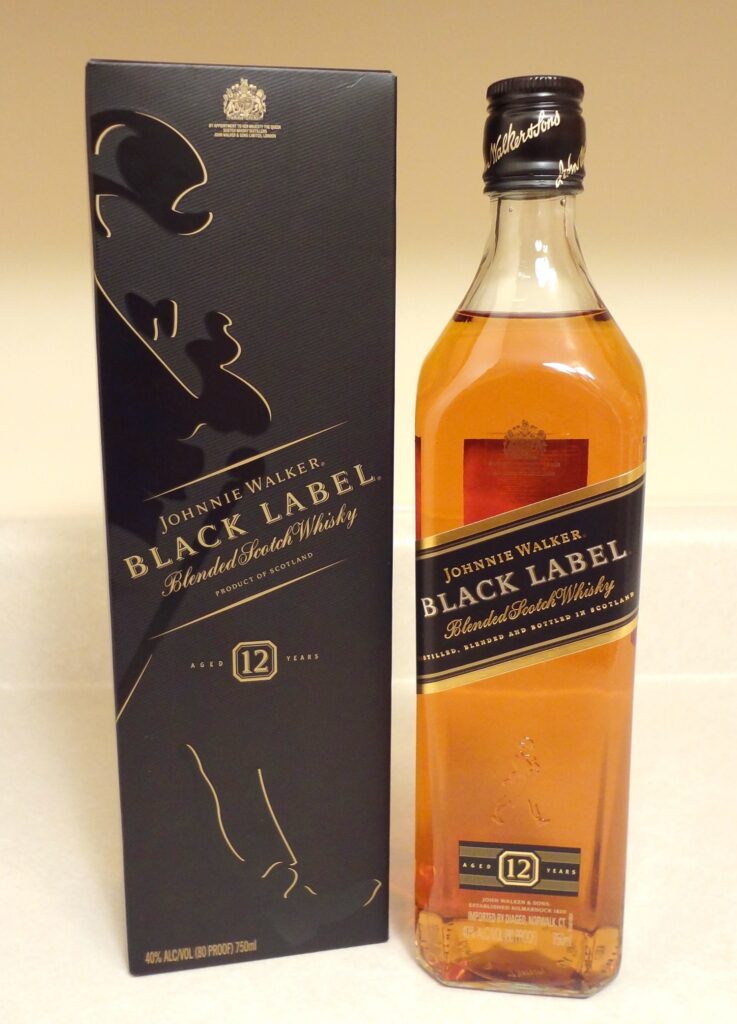
Retained example and source context. Johnnie Walker Black Label supplies a documented blended-Scotch reference. Its particular profile is illustrative, not the required profile of every blend. ADI scope: S124; the Scotch specification.
Photo credit
Johnnie Walker Black Label blended Scotch whisky. Photo: Iceman7840 / Wikimedia Commons. CC BY-SA 3.0. Display resized; no other edits.

Keep exploring
- Scotch Whisky product specification — evidence reviewed 2026-09-17.
- 27 CFR 5.143 — evidence reviewed 2026-09-18.