
Irish Single Malt Whiskey
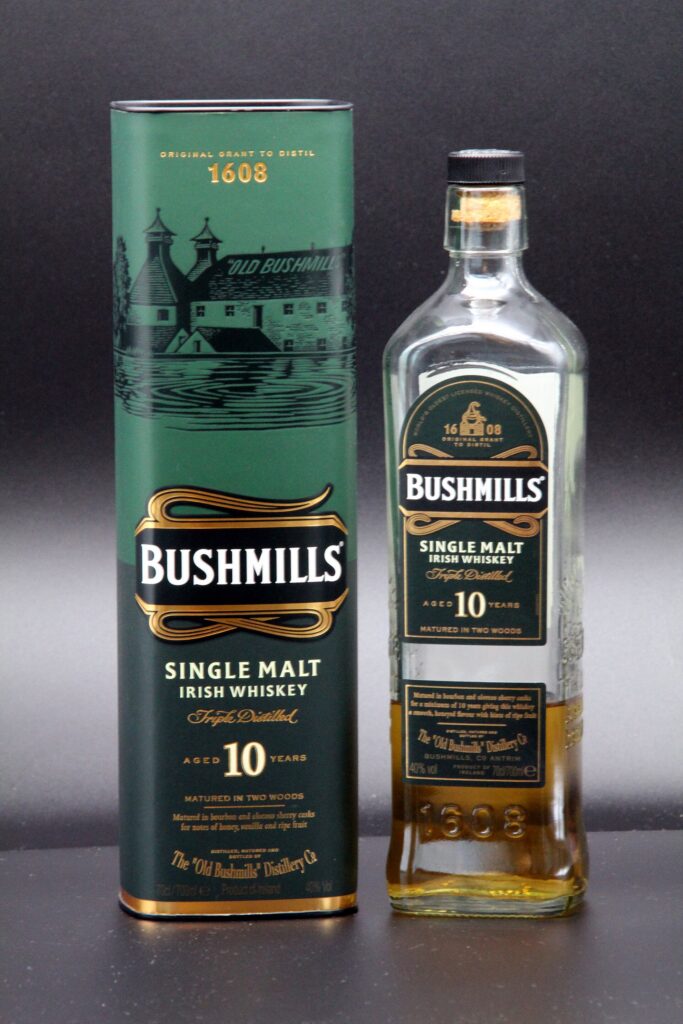
Malted-barley whiskey from one Irish distillery, with potential notes of cereal, orchard fruit, honey-like aromas, vanilla, nuts and wood spice. Peated examples also exist. The style ranges from delicate and floral to rich and cask-driven, with no requirement that every example share a light national house style.
Color
Maturation
Alcohol
Sweetness
Balance
History
Irish single malt’s historical record requires care with famous founding dates. The Causeway Coast heritage account identifies the Bushmills distillery with 1784, while the often-cited 1608 date refers to a regional license to distill. Those are different events, and the earlier license does not prove uninterrupted operation of the present company. Bushmills provides a significant producer history without supplying a universal invention date for Irish single malt. Causeway Coast and Glens heritage guide: Bushmills.
Classic characteristics
Appearance
Pale gold through deep amber; assess appearance without converting colour into an age estimate.
Aroma
Medium to pronounced malt, fruit, vanilla, nuts and floral notes; smoke only where the expression supports it.
Flavor
Malt and fermentation fruit with variable oak, dried fruit, chocolate or peat-derived character.
Sweetness
Dry with sweet-associated malt, honey or vanilla impressions; IR excludes sweetening.
Mouthfeel
Medium to full, silky, rounded or oily; strength and cask tannin alter the impression.
Finish
Medium to long in many examples; flavour quality and balance matter more than length alone.
Flavor Profile Deep Dive
Judge malt, distillation and maturation together; double-distilled Irish malt is not inherently outside the style. Investigate persistent solvent-like pungency, unpleasant stale character or wood astringency that overwhelms the intended expression. A descriptor alone cannot prove a distillation-cut error, additive use or chemical safety.
Service notes
Pair a single malt with a single pot still from a comparable age and strength range. Focus on observed malt, fruit, spice and texture while avoiding claims that every difference comes from unmalted barley. Explain the particular producer's distillation count only when verified. Encourage consumers to choose by flavour direction and cask preference rather than assuming all Irish whiskey is a blended, triple-distilled product.
Style parameters
| Parameter | Boundary or expectation |
|---|---|
| Base material | Malted barley |
| Bottled strength | IR applies; record the specific bottle rather than assuming all Irish malt is 40%. |
| Ireland, island of: bottled ABV | at least 40%; see identity requirements. |
| United States: bottled ABV | at least 40%; Whiskey identity; protected origin and named types have additional rules. |
| Color and clarity | Pale gold through deep amber; assess appearance without converting colour into an age estimate. |
| Maturation | IR applies; sherry, bourbon and other documented cask histories give different expressions. |
| Additions | IR applies; a honey aroma does not mean honey was added. |
Legal limits apply only to the named jurisdiction and identity. ADI entry conditions and typical sensory expectations are separate; a product example is not a universal range.
Cocktail connections
Style comparison
Irish single pot still includes substantial unmalted barley and is a different identity, even though both use pot stills. Irish single malt can resemble some Scotch single malts sensorially, but origin and national rules remain distinct. Absence of smoke is common in many familiar bottles, not a requirement for Irish origin. A cask-strength release should not be judged against a lower-strength reference without considering dilution.
Related styles: Irish Single Pot-Still Whiskey · Scottish Single Malt Whisky.
Ingredients
Malted barley
Production notes
the Irish whiskey specification establishes the single-distillery malt and pot-distillation requirements alongside the shared Irish framework. Double and triple distillation are both possible in the published specification. A producer may combine many qualifying casks while retaining single-malt status. Fermentation and still operation influence fruit and texture; cask history supplies another major source of variation. Neither the number of distillations nor the word “single” provides an automatic quality ranking.
Commercial examples
No newly verified benchmark is designated in this revision. The original example discussion below remains a research lead, with its original qualifications.
Retained example and source context. Bushmills 10 Year Old Single Malt documents triple distillation and sherry- and bourbon-seasoned barrels. ADI scope: S117; the Irish whiskey specification.
Photo credit
Bushmills 10 Year Old single malt Irish whiskey. Photo: Datenralfi / Wikimedia Commons. CC BY-SA 3.0. Display resized; no other edits.

Keep exploring
- Published Irish whiskey specification; consultation distinguished from adoption — evidence reviewed 2026-09-17.
- 27 CFR 5.143 — evidence reviewed 2026-09-18.