
International Blended Whisky
A whisky assembled from grain and malt whiskies outside the more specifically named ADI national groupings. It may be light and fruit-forward, richly malty, strongly influenced by wine casks or deliberately smoky. The category's breadth makes balance and clarity more useful than a single mandatory flavour signature.
Color
Maturation
Alcohol
Sweetness
Balance
History
International Blended Whisky brings together national traditions and products rather than one historical invention. Suntory’s introduction of Hibiki in 1989 provides a documented Japanese example of blending developed into a prominent brand identity. That milestone illustrates the category’s geographical breadth. It should not be treated as the beginning of Japanese blending, or as a date shared by blends produced in other countries. House of Suntory: company and whisky chronology.
Classic characteristics
Appearance
Pale gold through deep amber; component casks and local treatment rules determine colour.
Aroma
Light to pronounced cereal, malt, fruit, vanilla and spice; wine influence or smoke may be prominent.
Flavor
An integrated combination of component characters; grain whisky can supply both flavour and structural lightness.
Sweetness
Usually dry to sweet-seeming, subject to actual formulation and national rules.
Mouthfeel
Light to full; rounded, oily or gently tannic according to the blend and casks.
Finish
Short to long, with a coherent progression rather than a requirement for maximum persistence.
Flavor Profile Deep Dive
Judge the documented grain/malt blend and origin; “international” does not require ingredients from several countries. Investigate persistent solvent-like pungency, unpleasant stale character or wood astringency that overwhelms the intended expression. A descriptor alone cannot prove a distillation-cut error, additive use or chemical safety.
Service notes
Ask staff to identify country, component types and cask influence before describing the blend. Compare with another whisky at similar strength and a similar flavour objective. A highball trial can show how a lighter grain component and a fruitier malt component behave after dilution. Avoid describing the product as “world whisky” in a way that implies multinational sourcing when it is entirely domestic.
Style parameters
| Parameter | Boundary or expectation |
|---|---|
| Base material | Fermented grain mash; identify grain and component types |
| Bottled strength | ADI minimum 40% ABV; legal destination requirements and actual strength still need confirmation. |
| Color and clarity | Pale gold through deep amber; component casks and local treatment rules determine colour. |
| Maturation | Follow the components' origin standards; ADI gives no universal age minimum for this grouping. |
| Additions | Governed by origin and market identity; do not transfer U.S. blended-whiskey permissions automatically. |
Legal limits apply only to the named jurisdiction and identity. ADI entry conditions and typical sensory expectations are separate; a product example is not a universal range.
Cocktail connections
Browse published cocktails. Documented recipes, conditional style choices and development substitutions are labeled separately.
No established classic or recognized modern cocktail match was found for this specific style in the sources reviewed. This records a research gap, not proof that no cocktail exists. No neighboring style has been substituted to fill the space.
Style comparison
This is broader geographically than blended Scotch and does not prescribe its exact component taxonomy. It also differs from a single malt assembled from many barrels at one distillery. A mixed-grain mash distilled together is not sufficient evidence of a blend of separately made grain and malt whiskies. Production records clarify whether the ADI definition is met.
Ingredients
Fermented grain mash; identify grain and component types
Production notes
ADI defines a blend of two or more grain and malt whiskies bottled at no less than 40% ABV. “International” is a competition grouping, not a country of origin or a globally harmonized legal identity. It does not require whisky from several countries. The producer's origin-country rules still govern the underlying whiskies, and import-market classification must be checked separately. A blend containing neutral alcohol should not be assumed to fit this wording.
Commercial examples
| Expression | Stated ABV | Source/market review | Eligibility note |
|---|---|---|---|
| Starward Two-Fold Wheat & Single Malt Whisky | 40% | Australia; 700 mL producer listing; checked 2026-09-18 | Documented wheat and malt blend matured in red-wine barrels; international category does not imply multinational ingredients. |
Retained example and source context. Starward Two-Fold documents Australian wheat and single malt whisky with red-wine-barrel maturation. ADI supplied definition: S112. Origin-specific statements apply to that example, not every international blend.
Photo credit
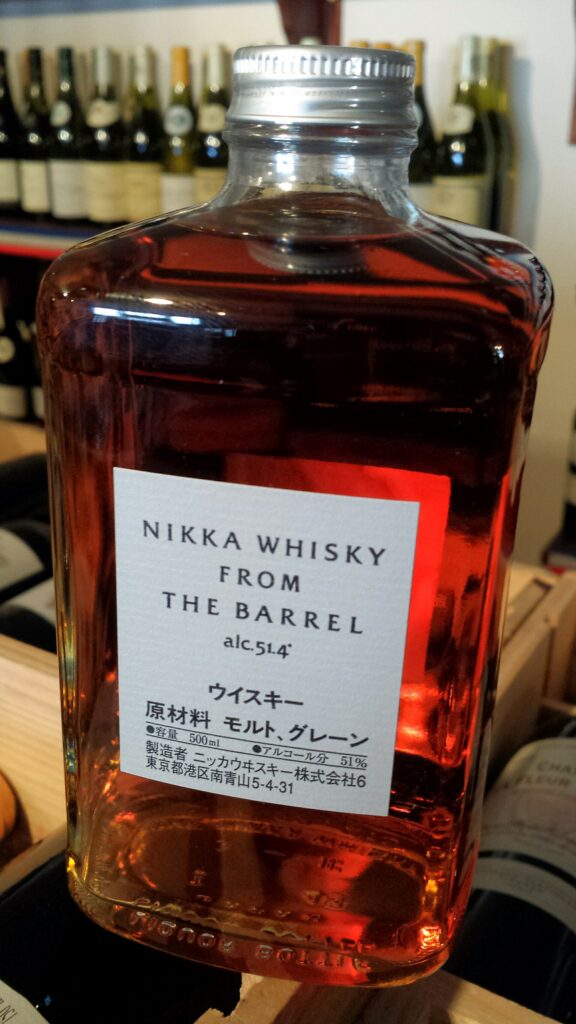
Nikka From the Barrel blended whisky. Photo: Dominic Lockyer / Wikimedia Commons. CC BY 2.0. Display resized; no other edits.
