
Blended Whiskey
An intentionally assembled whiskey whose character can range from light and restrained to richly grain- and oak-driven. ADI groups several legally distinct U.S. blend identities here. There is consequently no single required level of malt, spice, body or complexity that accurately describes the whole entry.
Color
Maturation
Alcohol
Sweetness
Balance
History
American blended whiskey’s legal history was shaped by arguments over what could be sold as whiskey after the 1906 Pure Food and Drugs Act. President William Howard Taft’s decision of December 27, 1909 addressed the naming of straight, blended and compounded products. That dispute helps explain the later importance of explicit blend terminology. It should not be flattened into a claim that blending itself was invented by the decision. William Howard Taft: whisky decision, December 27, 1909.
Classic characteristics
Appearance
Pale gold through deep amber; composition, wood and permitted treatments influence colour.
Aroma
Light to pronounced cereal, vanilla, caramel-like aromas, fruit and spice; intensity follows the actual blend.
Flavor
Restrained or full whiskey character, with the components forming a coherent flavour progression.
Sweetness
Dry to sweet-seeming; permitted formulation differences require documentation rather than assumption.
Mouthfeel
Light and easy-flowing through full and oily; judge integration at the stated strength.
Finish
Short to long; a clean, proportionate finish can suit a deliberately light blend.
Flavor Profile Deep Dive
Identify the specific blend category before scoring; authorized neutral spirit is not a contaminant or an automatic fault. Investigate persistent solvent-like pungency, unpleasant stale character or wood astringency that overwhelms the intended expression. A descriptor alone cannot prove a distillation-cut error, additive use or chemical safety.
Service notes
Begin with a label-reading exercise before blind comparison. Record the full identity, disclosed neutral-spirit proportion where applicable, strength and age wording. Compare within like subtypes before drawing conclusions about value or intensity. Test a standardized highball as a separate service exercise; a restrained spirit can work effectively without needing the concentration of a sipping whiskey. Explain actual composition in plain language and avoid using “blend” as a dismissal.
Style parameters
| Parameter | Boundary or expectation |
|---|---|
| Base material | Fermented grain mash; identify grain and component types |
| Bottled strength | At least 40% ABV under the U.S. whiskey identity; record the exact bottle strength. |
| United States: bottled ABV | at least 40%; Whiskey identity; protected origin and named types have additional rules. |
| Color and clarity | Pale gold through deep amber; composition, wood and permitted treatments influence colour. |
| Maturation | Components and subtype determine requirements; do not assign the oldest component's age to the blend. |
| Additions | Neutral spirit and permitted treatments depend on the exact subtype; the U.S. blended-whiskey rule distinguishes the main cases. |
Legal limits apply only to the named jurisdiction and identity. ADI entry conditions and typical sensory expectations are separate; a product example is not a universal range.
Cocktail connections
Browse published cocktails. Documented recipes, conditional style choices and development substitutions are labeled separately.
No established classic or recognized modern cocktail match was found for this specific style in the sources reviewed. This records a research gap, not proof that no cocktail exists. No neighboring style has been substituted to fill the space.
Style comparison
The word “blended” is not an international recipe. Scotch blends combine regulated Scotch whiskies, while the ordinary U.S. category can include neutral spirit. Blended straight whiskey should not be described as necessarily diluted with neutral spirit. Neither blend status nor single-distillery status is a quality score. The blender's objective might be consistency, a particular cocktail performance or greater sensory complexity.
Ingredients
Fermented grain mash; identify grain and component types
Production notes
Read the complete designation using the U.S. blended-whiskey rule. Ordinary U.S. blended whiskey can include neutral spirit; a blend of straight whiskeys represents a different composition. Blended bourbon and similar named forms have their own minimum named component. These percentages are based on alcohol contribution, not simply the volume of liquids poured together. The everyday act of combining barrels does not, by itself, make a bourbon legally “blended whiskey.”
Commercial examples
No newly verified benchmark is designated in this revision. Select a documented qualifying expression before running a benchmark tasting.
Retained example and source context. ADI scope: S105; the U.S. whiskey and blend rules. This umbrella requires subtype-matched teaching bottles rather than one purported universal benchmark.
Photo credit
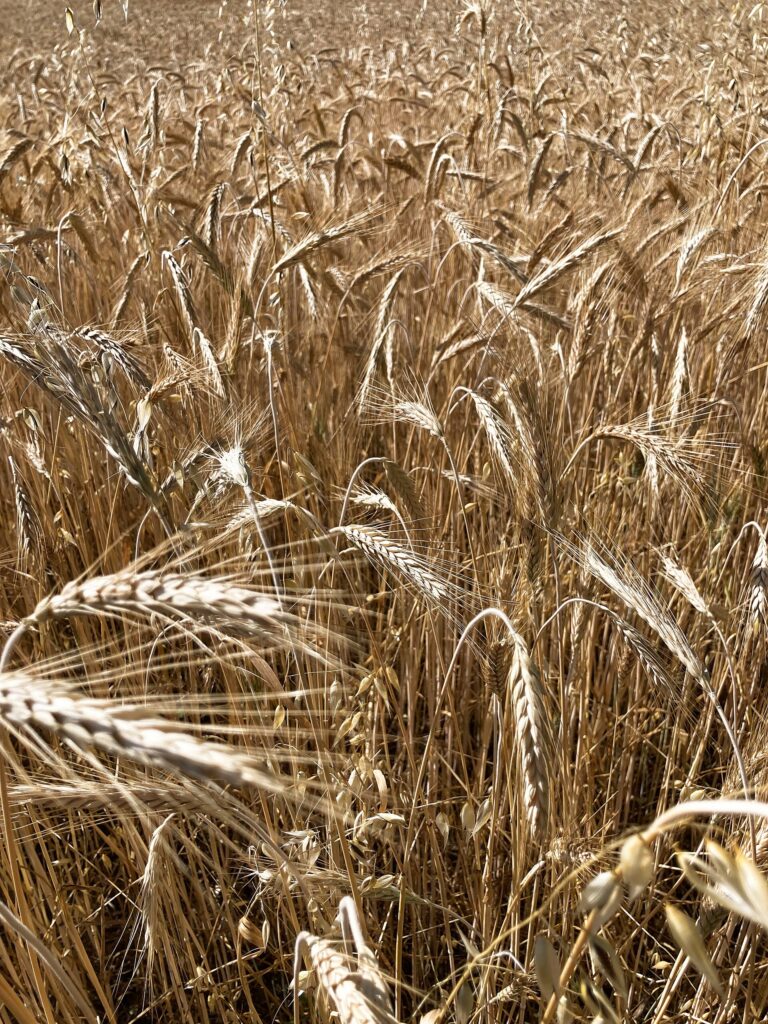
Ingredient or production reference: Wheat growing in a field, one grain used in whiskey. This photograph illustrates the raw material or process, not a bottle of this specific style. Photo: Michele Castagnetti / Wikimedia Commons. CC BY-SA 4.0. Display resized; no other edits.

Keep exploring
- 27 CFR 5.143 — evidence reviewed 2026-09-18.