
Other Specialty Spirits
A deliberately open category for spirits that do not fit ADI's regular entries. There is no single legitimate colour, aroma, sweetness or strength target. Evaluation begins with the producer's declared concept, raw materials and process, then asks whether the liquid communicates that concept with balance and definition.
Color
Maturation
Alcohol
Sweetness
Balance
History
Other Specialty Spirits is an organizing category for products that do not fit the named styles, so it has no common invention date. St. George’s distillery chronology illustrates the sort of modern diversification behind such groupings: a producer founded around fruit eau-de-vie in 1982 subsequently expanded into multiple spirit families. That is context for experimentation, not a claim that the distillery originated this ADI category or that every one of its products belongs here. St. George Spirits: distillery chronology.
Classic characteristics
Appearance
Establish from the declared process; no fixed colour, depth or clarity standard applies.
Aroma
Describe actual intensity and raw-material, fermentation, maturation or addition-derived character separately.
Flavor
Judge identifiable flavour, integration and correspondence with the stated concept rather than a generic ideal.
Sweetness
Any level may be appropriate if intentional and balanced; record observed sweetness explicitly.
Mouthfeel
Light to rich, with warmth, oiliness, astringency or other sensations evaluated in context.
Finish
Short to long; persistence is useful only when its flavours remain coherent and appropriate.
Flavor Profile Deep Dive
Agree a declared intended profile and evaluation method before scoring; innovation does not excuse incoherence or unexplained defects. Investigate persistent unpleasant solvent-like, stale or sulfurous character in context. Do not diagnose a specific production error from one aroma; appropriate fermentation character and proof-related warmth are not automatic faults.
Service notes
Ask staff to write a plain-language identity sentence before writing tasting notes: what was fermented or distilled, what was added and what happened afterward. Compare with the closest established style only to clarify differences. For consumers, prioritize the dominant flavours and practical role over technical novelty. Keep uncertain process claims out of the guest description until supported by producer documentation.
Style parameters
| Parameter | Boundary or expectation |
|---|---|
| Base material | Declared fermentable material and formulation |
| Bottled strength | Use verified product ABV; ADI supplies no category-wide numerical requirement. |
| Color and clarity | Establish from the declared process; no fixed colour, depth or clarity standard applies. |
| Maturation | As declared and substantiated; no universal vessel, duration or treatment is implied. |
| Additions | Require a clear ingredient and process statement sufficient to understand the product's intended identity. |
Legal limits apply only to the named jurisdiction and identity. ADI entry conditions and typical sensory expectations are separate; a product example is not a universal range.
Cocktail connections
Style comparison
This category accommodates genuine boundary cases; it does not suspend legal labelling requirements or turn every novel flavour into a new spirit class. A clear production narrative is especially important because familiar style expectations cannot fill missing information. Novelty and quality are separate judgments: an unusual idea may be well or poorly executed.
Ingredients
Declared fermentable material and formulation
Production notes
ADI provides an innovation-based residual category rather than a recipe. Possible products may combine unusual fermentable materials, unconventional flavouring or processes that cross established style boundaries. Such possibilities are illustrative, not a list of authorized legal names. A product should not be placed here merely because its actual identity has not been researched; first check whether another ADI entry already describes it.
Commercial examples
No newly verified benchmark is designated in this revision. Select a documented qualifying expression before running a benchmark tasting.
Retained example and source context. ADI supplied source, S083. No universal commercial benchmark or origin-country standard can represent this residual category. Parameters above are an original evaluation framework, not evidence that any hypothetical production method is legally permitted.
Photo credit
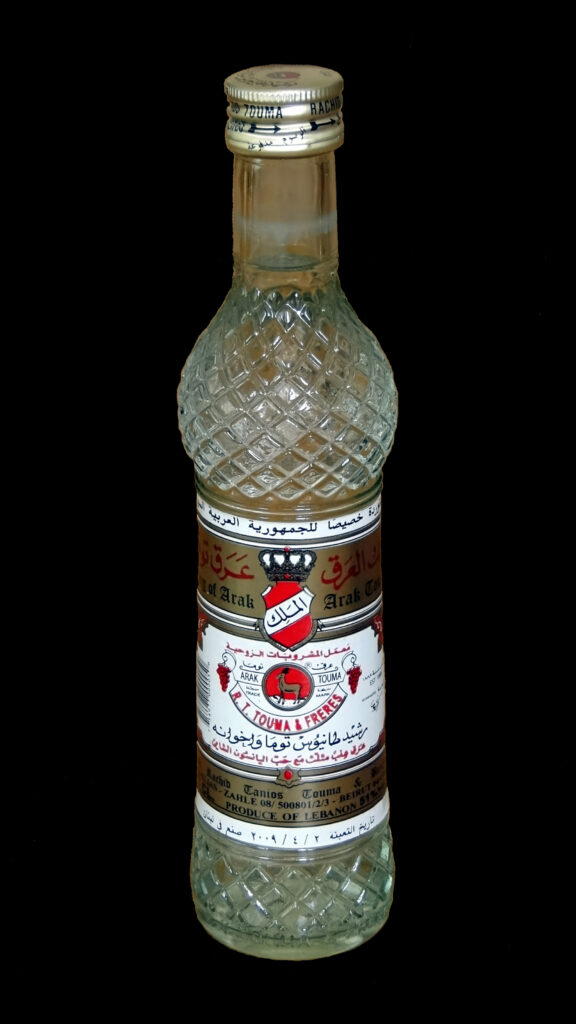
Arak Touma from Lebanon. Photo: Bernard Gagnon / Wikimedia Commons. CC BY-SA 3.0. Display resized; no other edits.
