
White Whiskey
A colourless or nearly colourless grain spirit presented in ADI's white-whiskey grouping, emphasizing cereal, dough, fresh fruit and fermentation character with little overt wood. Successful examples can be lively, rounded and expressive. A raw or solvent-dominated finish is not required simply because the spirit lacks mature oak flavours.
Color
Maturation
Alcohol
Sweetness
Balance
History
White whiskey preserves the distinction between newly distilled grain spirit and the later importance of wood maturation. Mount Vernon’s account describes Washington’s ordinary whiskey as sold unaged, providing a documented early American example. Modern white-whiskey products can refer back to that production stage without inheriting a history of illegal manufacture. “White” and “moonshine” therefore overlap in popular language but are not historically interchangeable. Mount Vernon: ten facts about Washington’s distillery.
Classic characteristics
Appearance
Colourless to very pale; the intended presentation shows little visible wood extraction.
Aroma
Medium to pronounced cereal, corn or other grain, dough, fresh fruit and possible floral notes.
Flavor
Grain and fermentation character lead; little vanilla, toast or tannin from maturation is expected.
Sweetness
Usually dry with fresh-grain or fruit sweetness of aroma; fermentation substrate does not guarantee residual sugar.
Mouthfeel
Light to full, sometimes oily or creamy; integrated alcohol remains important without wood softening.
Finish
Short to long, carrying grain and fruit; cleanliness matters more than imitation of mature whiskey.
Flavor Profile Deep Dive
Judge grain and fermentation expression without required mature oak flavors; confirm legal identity separately from its clear appearance. Investigate persistent unpleasant solvent-like, stale or sulfurous character in context. Do not diagnose a specific production error from one aroma; appropriate fermentation character and proof-related warmth are not automatic faults.
Service notes
Compare a documented unaged corn whiskey with a matured corn whiskey to demonstrate grain and wood contributions. If using a distillery's new make, identify it accurately as new make rather than assigning an unsupported whiskey label. Staff should explain the fresh cereal and fruit profile on its own terms, and assess cocktail performance through actual flavour and proof rather than treating it as interchangeable with vodka.
Style parameters
| Parameter | Boundary or expectation |
|---|---|
| Base material | Fermented grain mash; identify grain and component types |
| Bottled strength | ADI minimum 40% ABV; actual bottle strength can be much higher. |
| United States: bottled ABV | at least 40%; Whiskey identity; protected origin and named types have additional rules. |
| Color and clarity | Colourless to very pale; the intended presentation shows little visible wood extraction. |
| Maturation | Absent or limited in the sensory concept; U.S. legal storage requirements depend on the underlying identity. |
| Additions | Verify formulation and designation; flavoured moonshine is not automatically an unmodified white whiskey. |
Legal limits apply only to the named jurisdiction and identity. ADI entry conditions and typical sensory expectations are separate; a product example is not a universal range.
Cocktail connections
Browse published cocktails. Documented recipes, conditional style choices and development substitutions are labeled separately.
No established classic or recognized modern cocktail match was found for this specific style in the sources reviewed. This records a research gap, not proof that no cocktail exists. No neighboring style has been substituted to fill the space.
Style comparison
White whiskey is not necessarily moonshine, and a legally produced unaged spirit is not evidence of illicit production. It differs from vodka through the relevant distillation and character requirements rather than colour alone. A very brief wood treatment may affect legal status without creating the flavour of a mature whiskey. Colourlessness itself cannot prove the absence of every maturation or filtration treatment.
Ingredients
Fermented grain mash; identify grain and component types
Production notes
ADI specifies fermented grain, distillation below 95% ABV, optional oak storage and bottling at least 40%. The optional-storage wording is broader than ordinary U.S. whiskey law: qualifying corn whiskey can be unaged, while other U.S. whiskey generally needs oak storage. Fresh bourbon mash distillate is therefore not automatically bourbon or even legally labelled whiskey before the required wood contact. The ADI heading should not replace the product's actual approved designation.
Commercial examples
| Expression | Stated ABV | Source/market review | Eligibility note |
|---|---|---|---|
| Ole Smoky Original | 50% | U.S. producer page; checked 2026-09-18 | Producer explicitly identifies unaged corn whiskey. This expression does not establish the identity of every product sold as moonshine. |
Retained example and source context. ADI supplied definition: S132; the U.S. whiskey standard. A qualifying unaged corn whiskey provides the clearest U.S. legal teaching example; other new-make products require designation-specific review.
Photo credit
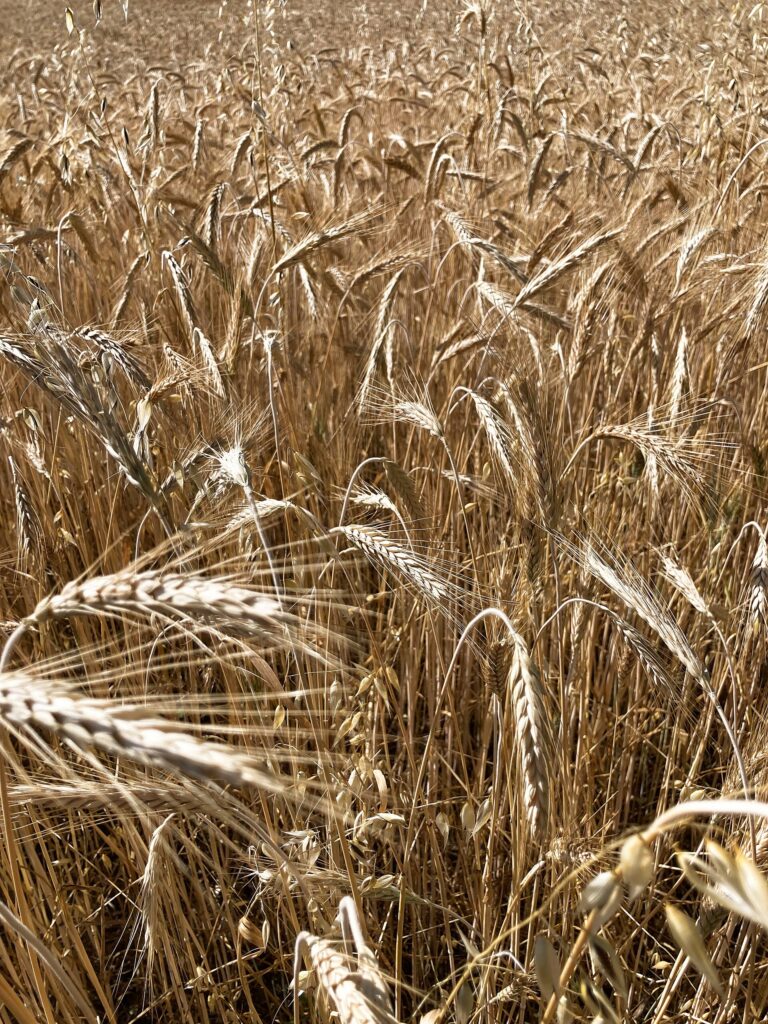
Ingredient or production reference: Wheat growing in a field, an unaged-whiskey raw material. This photograph illustrates the raw material or process, not a bottle of this specific style. Photo: Michele Castagnetti / Wikimedia Commons. CC BY-SA 4.0. Display resized; no other edits.

Keep exploring
- 27 CFR 5.143 — evidence reviewed 2026-09-18.