
Pot Still Rum
Cane-derived rum produced in pot stills, often with expressive fruit, fermentation and a rounded texture, but not necessarily intensely funky or heavy. Unaged examples foreground distillate character; aged ones may add vanilla, spice, dried fruit and tannin. Balance matters more than maximum ester intensity.
Color
Maturation
Alcohol
Sweetness
Balance
History
Pot-still rum belongs to the early commercial rum economy, which connected Caribbean sugar production with Atlantic trade. Museum research on Boston’s rum and molasses commerce documents the industry’s entanglement with slavery and the labor that supported plantation production. That setting is essential historical context, rather than a decorative origin story. The pot-still heading groups a production method across regions and does not identify one inventor or a uniform national style. West End Museum: rum, molasses and slavery in Boston.
Classic characteristics
Appearance
Colourless when unaged or filtered; gold to deep amber with maturation or other permitted treatment.
Aroma
Medium to pronounced fruit, cane, fermented or molasses-associated notes; oak and spice where matured.
Flavor
Fruit and fermentation character often evident; savoury or estery complexity can range from subtle to intense.
Sweetness
Usually dry to sweet-seeming from aroma; actual sugar addition is a separate, documented matter.
Mouthfeel
Medium to full is common, sometimes oily; lighter pot-distilled expressions remain legitimate.
Finish
Medium to long; fruit, spice and optional oak should persist without an uncontrolled coarse edge.
Flavor Profile Deep Dive
Assess the documented pot-distilled expression; pronounced funk is legitimate in some examples but not a required target. Investigate persistent unpleasant solvent-like, stale or sulfurous character in context. Do not diagnose a specific production error from one aroma; appropriate fermentation character and proof-related warmth are not automatic faults.
Service notes
Select benchmarks with documented equipment and compare at similar strengths. Teach tasters to name actual fruit, savoury and fermentation impressions rather than stop at “funky.” For aged examples, separate distillate character from wood extraction. In consumer language, describe the specific bottle's intensity and texture; use the still discussion to explain variation rather than imply an automatic quality hierarchy.
Style parameters
| Parameter | Boundary or expectation |
|---|---|
| Base material | Sugarcane juice, syrup, molasses or other cane-derived material; identify product |
| Bottled strength | ADI minimum 40% ABV; higher-strength examples also overlap S093 when its threshold is met. |
| United States: bottled ABV | at least 40%; Ordinary rum/cachaça identity; origin requirements remain applicable. |
| Color and clarity | Colourless when unaged or filtered; gold to deep amber with maturation or other permitted treatment. |
| Maturation | Optional under ADI; vessel, climate and duration influence aged versions but are not fixed here. |
| Additions | Origin- and product-specific; pot distillation itself establishes no universal sweetening or colour rule. |
Legal limits apply only to the named jurisdiction and identity. ADI entry conditions and typical sensory expectations are separate; a product example is not a universal range.
Cocktail connections
Browse published cocktails. Documented recipes, conditional style choices and development substitutions are labeled separately.
- Añejo Highball — qualified; base.
- Bacardi Cocktail — qualified; base.
- Bermuda Rum Swizzle — qualified; base.
- Between The Sheets — qualified; co-base.
- Cuba Libre — qualified; base.
- Daiquiri — qualified; base.
- Dark ’n Stormy — qualified; base.
- Don’s Special Daiquiri — qualified; co-base.
- Eggnog — qualified; base.
- El Presidente — qualified; base.
- Fog Cutter — qualified; co-base.
- Hemingway Special — qualified; base.
- Hot Buttered Rum — qualified; base.
- IBA Tiki — qualified; co-base.
- Jungle Bird — qualified; base.
- Long Island Iced Tea — qualified; co-base.
- Mai Tai — qualified; base.
- Mary Pickford — qualified; base.
- Missionary’s Downfall — qualified; base.
- Mojito — qualified; base.
- Old Cuban — qualified; base.
- Painkiller (Pusser’s reference) — qualified; base.
- Piña Colada — qualified; base.
- Planters Punch — qualified; base.
- Queen’s Park Swizzle — qualified; base.
- Three Dots And A Dash — qualified; co-base.
- Zombie — qualified; co-base.
Style comparison
Pot production separates the category from column-only and mixed-still blends. “Funk” is an informal sensory shorthand, not a requirement or precise chemical measurement. A restrained pot rum should not be rejected for lacking the extreme fermented-fruit aroma of a particular Jamaican reference. Similarly, a rich mouthfeel does not prove a pot-still origin.
Ingredients
Sugarcane juice, syrup, molasses or other cane-derived material; identify product
Production notes
ADI permits cane juice, syrup, molasses and other cane by-products, with optional oak ageing and a 40% bottling minimum. Pot design, retorts, fermentation and distillation choices produce substantial variation. The U.S. distillation boundary differs slightly from ADI's wording; see the U.S. rum rule. A pot-still claim should describe the rum's actual production, not merely one component of a mixed-still blend.
Commercial examples
No newly verified benchmark is designated in this revision. The original example discussion below remains a research lead, with its original qualifications.
Retained example and source context. Worthy Park's production history documents its pot-and-twin-retort system. Mount Gay Pot Still Rum supplies another documented expression. ADI scope: S094; the U.S. rum rule.
Photo credit
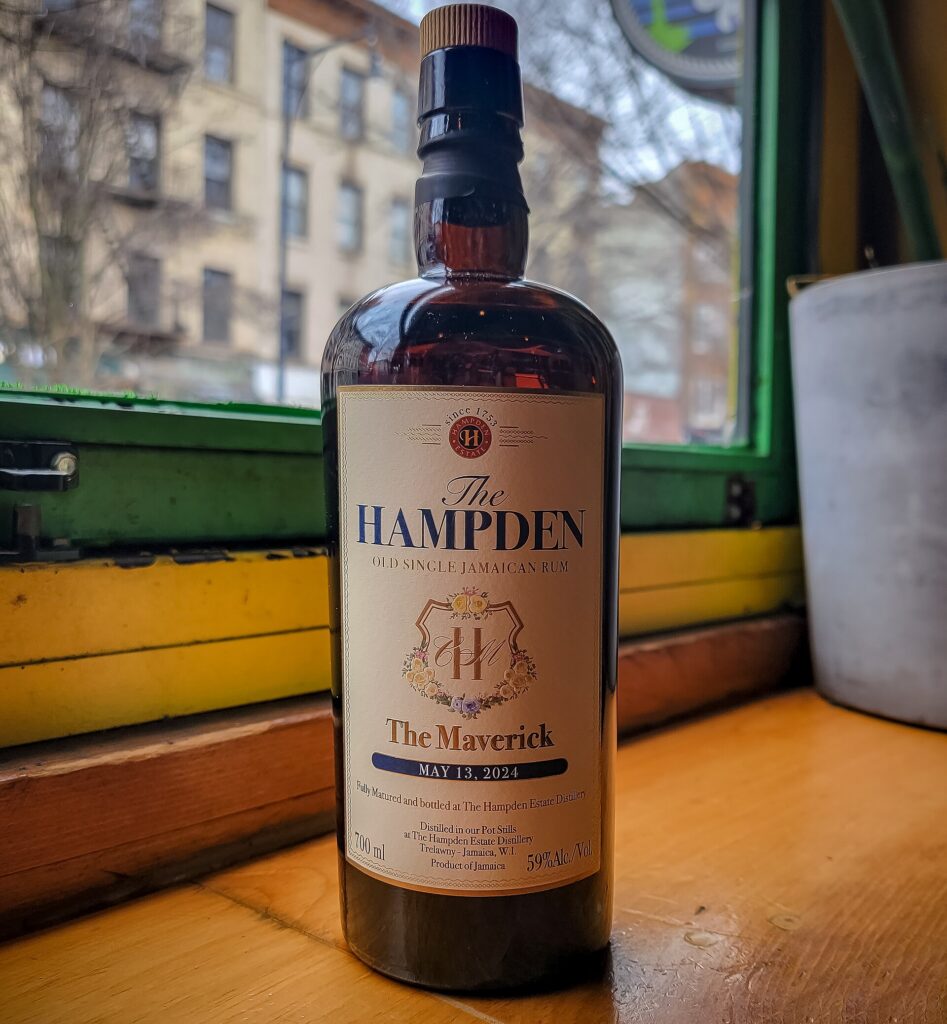
Hampden The Maverick rum. Photo: 10art1 / Wikimedia Commons. CC BY-SA 4.0. Display resized; no other edits.

Keep exploring
- 27 CFR 5.147 — evidence reviewed 2026-09-17.