Black Flannel Academy

English IPA

bitter ยท british-isles ยท craft-style ยท hoppy ยท old world ยท pale-color ยท top-fermented
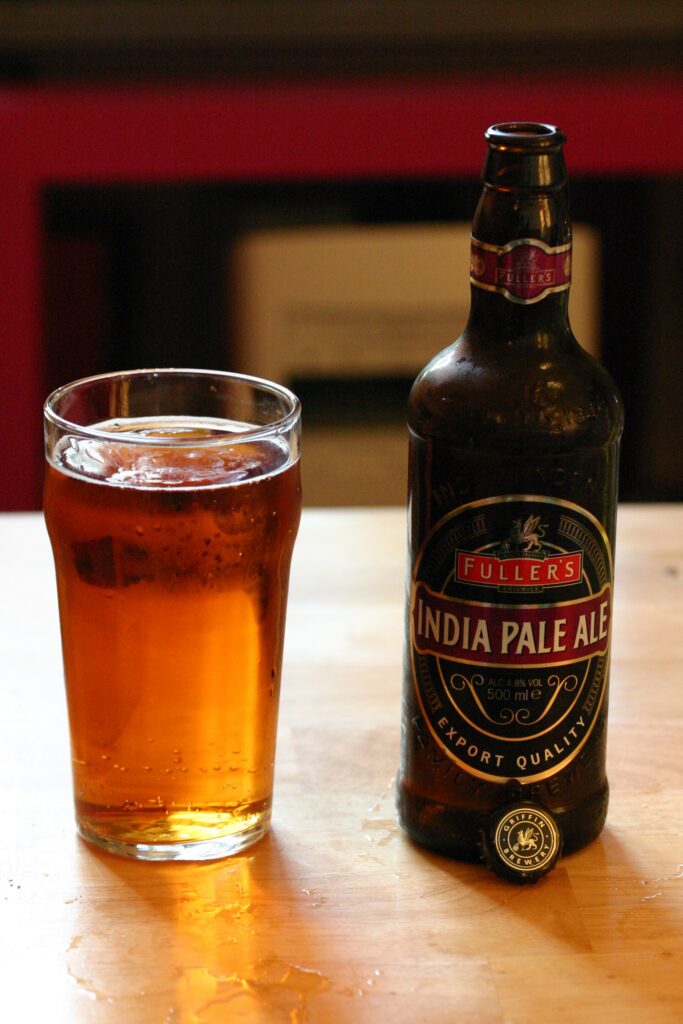
Fullerโ€™s India Pale Ale
Pictured: Fullerโ€™s India Pale Ale. Photo: Tom k&e / Wikimedia Commons ยท CC BY-SA 3.0. Display crops and resized versions are available under the same license.

A hoppy, moderately-strong, very well-attenuated pale British ale with a dry finish and a hoppy aroma and flavor. Classic British ingredients provide the best flavor profile.

Color

6 – 14 SRM

Bitterness

40 – 60 IBU

Alcohol

5.0 – 7.5% ABV

Sweetness

Medium through high bitterness Enough malt sweetness to fill out the palate Clean, hoppy finish

Balance

Medium through high bitterness Enough malt sweetness to fill out the palate Clean, hoppy finish

History

Historical Development

The history of India Pale Ale is easily the most misunderstood and mischaracterized story in beer. The pop culture tale we're often sold is that when brewers in England needed a way to get their beer to India without losing it to spoilage, they tossed in all the hops they could find so that it would survive the long journey. Yes, the acids from hops do act as a preservative against bacterial contamination, but that story is just lies. Let's explore what really happened, or at least what we can piece together of it (which isn't all that much).

The real story starts with the English defeat of the Spanish armada in 1588, after which British merchants asked the Queen for permission to sail to the Indian Ocean with the goal of taking a market from the destabilized Spanish traders. When the British arrived, they promptly started dying from tainted liquor in the region, which prompted brewers to send their beer to India on the merchant ships for Englishmen working in India. Contrary to that story we're all told, newspaper ads from Calcutta clearly show that even in the earlier years, ships were bringing everything from porter to pale ale to cider with them on their trips.

Just like the origins of American Lager, it's not always the first person to do something that gets credit for its invention. In this case, it was just the person who gamed the system a little bit better. George Hodgson's brewery, who are often wrongly credited with "inventing" this style, happened to sit near the East India Company's docks on the River Thames in London. When his son Mark took over the family business, he recognized an opportunity in the Indian market, and cut deals with the trading vessels to bring beer that was popular in India, and do it a bit cheaper than others would. Hodgson was hardly the first person to brew a pale ale in England, and highly hopped beer had existed for centuries on country estates. In addition to the "small beer" they made for everyday drinking, estate brewers made beer with the finest of harvested ingredients every October that was meant to be set until the following October. They used higher-than-average malt bills, partially to boost the alcohol for aging but also because they were making two or three beers from one mash. On the low end, these so-called "October" beers were around 8% ABV, and they only went up from there. They also used higher-than-average hop bills, with one recipe from the 1700s having nearly two pounds per barrel. As a final piece to this tasty, boozy puzzle, the invention of coke-fired malt kilns would have made it possible to create pale versions of these October beers.

So early versions of the IPA were around for at least a century, likely more, before they're supposedly "invented" by Hodgson. What Hodgson's company did do is intelligently take advantage of a new market, and make a product that was wildly popular there. This might have made them a bit overconfident, however. When Hodgson's son Mark began demanding more difficult trading terms with the East India Company, and at about the same time as a new channel opened to Burton on Trent making trade easier, the Allsopp brewery began brewing a similar beer. With the Burton water chemistry, those ingredients yielded a drier, more hop-focused beer that became the benchmark of the style.

So unfortunately IPAs, like American Lager, were born out of intelligent business practice rather than passionate brewing practice. Honestly, though, that doesn't really matter…the beer caught on because it was (and continues to be) an awesome showcase of one of our favorite plants: the almighty hop. For a style that has become the third most popular in America–behind only American Lager and American Light Lager–and seen a truly unexaggeratable amount of experimentation within the past several decades, the early IPA brewers clearly had something right.

You won't find many English IPAs on taplists in the States, but you will find American takes on it, and lots of them. We continue to love IPAs in this country, so however the history shook out, let's just be glad it did.

Modern Evolution

Accounts of its origins vary, but most agree that what became later known as IPA was pale ale prepared for shipment to India in the late 1700s and early 1800s. George Hodgson of the Bow Brewery became well-known as an exporter of IPA during the early 1800s, and is the first name frequently mentioned with its popularity. Burton breweries with their high-sulfate water were able to successfully brew IPA and began their domination of this market by the 1830s, around the time the name India Pale Ale was first used. Strength and popularity declined over time, and the style virtually disappeared in the second half of the 20th century. The style underwent a craft beer rediscovery in the 1980s. White Shield is probably the example with the longest lineage, tracing to the strong Burton IPAs of old and first brewed in 1829.

Classic characteristics

Appearance

Gold to light amber. Some of these are darker than you might expect.

Aroma

Hop forward Earthy, herbal, and woodsy hops Enough malty backbone to balance

Flavor

Medium through high bitterness Enough malt sweetness to fill out the palate Clean, hoppy finish

Mouthfeel

Medium-light body Clean, dry finish

Flavor Profile Deep Dive

Service notes

BJCP designation

Overall Impression: A hoppy, moderately-strong, very well-attenuated pale British ale with a dry finish and a hoppy aroma and flavor. Classic British ingredients provide the best flavor profile.

Aroma: A moderate to moderately-high hop aroma of floral, spicy-peppery or citrus-orange in nature is typical. A slightly grassy dry-hop aroma is acceptable, but not required. A moderately-low caramel-like or toasty malt presence is optional. Low to moderate fruitiness is acceptable. Some versions may have a sulfury note, although this character is not mandatory.

Appearance: Color ranges from golden to deep amber, but most are fairly pale. Should be clear, although unfiltered dry-hopped versions may be a bit hazy. Moderate-sized, persistent head stand with off-white color.

Flavor: Hop flavor is medium to high, with a moderate to assertive hop bitterness. The hop flavor should be similar to the aroma (floral, spicy-peppery, citrus-orange, and/or slightly grassy). Malt flavor should be medium-low to medium, and be somewhat bready, optionally with light to medium-light biscuit-like, toasty, toffee-like and/or caramelly aspects. Medium-low to medium fruitiness. Finish is medium-dry to very dry, and the bitterness may linger into the aftertaste but should not be harsh. The balance is toward the hops, but the malt should still be noticeable in support. If high sulfate water is used, a distinctively minerally, dry finish, some sulfur flavor, and a lingering bitterness are usually present. Some clean alcohol flavor can be noted in stronger versions. Oak is inappropriate in this style.

Mouthfeel: Smooth, medium-light to medium-bodied mouthfeel without hop-derived astringency, although moderate to medium-high carbonation can combine to render an overall dry sensation despite a supportive malt presence. A low, smooth alcohol warming can and should be sensed in stronger (but not all) versions.

Comments: The attributes of IPA that were important to its arrival in good condition in India were that it was very well-attenuated, and heavily hopped. Simply because this is how IPA was shipped, doesn't mean that other beers such as Porter weren't also sent to India, that IPA was invented to be sent to India, that IPA was more heavily hopped than other keeping beers, or that the alcohol level was unusual for the time. Many modern examples labeled IPA are quite weak in strength. According to CAMRA, "so-called IPAs with strengths of around 3.5% are not true to style."

History: Accounts of its origins vary, but most agree that what became later known as IPA was pale ale prepared for shipment to India in the late 1700s and early 1800s. George Hodgson of the Bow Brewery became well-known as an exporter of IPA during the early 1800s, and is the first name frequently mentioned with its popularity. Burton breweries with their high-sulfate water were able to successfully brew IPA and began their domination of this market by the 1830s, around the time the name India Pale Ale was first used. Strength and popularity declined over time, and the style virtually disappeared in the second half of the 20th century. The style underwent a craft beer rediscovery in the 1980s. White Shield is probably the example with the longest lineage, tracing to the strong Burton IPAs of old and first brewed in 1829.

Characteristic Ingredients: Pale ale malt. English hops are traditional, particularly as finishing hops. Attenuative British ale yeast. Refined sugar may be used in some versions. Some versions may show a sulfate character from Burton-type water, but this is not essential to the style.

Style Comparison: Generally will have more finish hops and less fruitiness and/or caramel than British pale ales and bitters. Has less hop intensity and a more pronounced malt flavor than typical American versions.

Vital Statistics: OG: 1.050 – 1.075 IBUs: 40 – 60 FG: 1.010 – 1.018 SRM: 6 – 14 ABV: 5.0 – 7.5%

Commercial Examples: Freeminer Trafalgar IPA, Fuller's Bengal Lancer IPA, Meantime India Pale Ale, Ridgeway IPA, Summit True Brit IPA, Thornbridge Jaipur, Worthington White Shield

Brewers Association designation

English-Style India Pale Ale Color: Gold to copper Clarity: Chill haze is acceptable at low temperatures Perceived Malt Aroma & Flavor: Medium malt flavor should be present Perceived Hop Aroma & Flavor: Medium to high, expressed as floral, herbal, earthy, stone fruit or other attributes from high hopping rates. While English hop character should be present, this can result from the skillful use of hops of other origin. Perceived Bitterness: Medium to high Fermentation Characteristics: Fruity esters are medium to high. Traditional interpretations are characterized by medium to medium-high alcohol content. The use of water with high mineral content results in a crisp, dry beer with a subtle and balanced character of sulfur compounds. Diacetyl can be absent or may be present at very low levels. Body: Medium Original Gravity: 1.046-1.064 (11.4-15.7 Plato) Final Gravity: 1.012-1.018 (3.1-4.6 Plato) Alcohol by Weight (Volume): 3.6%-5.6% (4.5%-7.1%) Bitterness (IBU): 35-63 Color SRM (EBC): 6-14 (12-28 EBC)

Style comparison

Parent Categories

Generally will have more finish hops and less fruitiness and/or caramel than British pale ales and bitters. Has less hop intensity and a more pronounced malt flavor than typical American versions.

Similar Styles from Other Classifications

Ingredients

Grain Bill

Two-row brewers malt Light caramel malts Lots of English hops Expressive English yeast

Brewing process

Mash Profile

A single infusion mash in the lower to middle range for saccharification is traditional to ensure good attenuation. Hopping rates vary depending on desired bitterness and aroma profile, but these beers include large bittering and late-hop, whirlpool, and dry-hop additions for added aromatic punch. Fermented around 68F for a clean yeast profile.

Food pairings

At the Pub: Scotch egg Takeout: Indian Casual date: Burgers and Fries

Desserts

Spirit pairings

Vermont Common

The soundtrack

New: The Clash Old: Ralph Vaughan Williams, Symphony No. 4

Keep exploring

Commercial Examples

Freeminer Trafalgar IPA, Fuller's Bengal Lancer IPA, Meantime India Pale Ale, Ridgeway IPA, Summit True Brit IPA, Thornbridge Jaipur, Worthington White Shield

International Breweries

Beer Cocktail Recipe

Radler

Ingredients
5 ounces IPA
3 ounces grapefruit juice
Grapefruit peel for garnish

Directions
Pour grapefruit juice into a highball glass without ice, then top with IPA and garnish with grapefruit peel.

Return to all beer styles

Scroll to Top