
Indian Single Malt Whisky
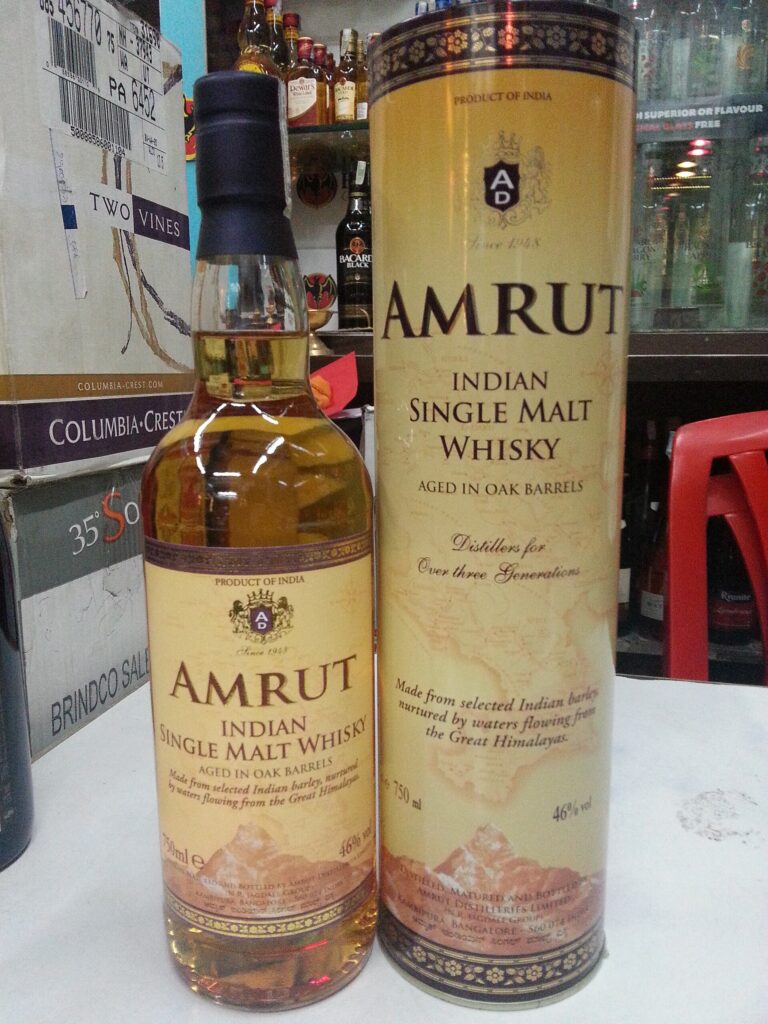
An Indian malted-barley whisky with expressions spanning fresh fruit and cereal through concentrated oak, spice, dried fruit and smoke. Many prominent examples combine vivid spirit character with substantial wood influence. Climate contributes to maturation, but India is too geographically varied for one national flavour prescription.
Color
Maturation
Alcohol
Sweetness
Balance
History
Indian single malt’s international commercial development has a firm milestone in Amrut’s launch of its single malt in Glasgow in 2004. The company’s history places that release within a longer Indian distilling business rather than treating it as India’s first production of any whisky. It is a significant event in bringing Indian-made single malt to an international audience, not proof that one launch created the whole national industry. Amrut: company and single-malt history.
Classic characteristics
Appearance
Gold to deep amber or copper; colour reflects cask treatment and any permitted adjustment.
Aroma
Medium to pronounced malt, orchard or tropical fruit, vanilla and spice; smoke depends on the expression.
Flavor
Malt and fruit with variable rich oak, cocoa, dried fruit or peat; intensity should remain balanced.
Sweetness
Usually dry to sweet-seeming through malt and wood associations; verify formulation before asserting sugar content.
Mouthfeel
Medium to full, rounded or oily, sometimes strongly tannic; assess alcohol and wood separately.
Finish
Medium to long; fruit, malt, spice or smoke can persist, without requiring all four.
Flavor Profile Deep Dive
Assess malt and cask integration on actual elapsed age; do not convert Indian years into a fictional Scottish age equivalent. Investigate persistent solvent-like pungency, unpleasant stale character or wood astringency that overwhelms the intended expression. A descriptor alone cannot prove a distillation-cut error, additive use or chemical safety.
Service notes
Compare two documented cask or peat treatments from the same producer before generalizing about the country. Dilute stronger samples gradually and note whether fruit or tannin becomes more evident. Staff can explain a bold, tropical-fruit or smoky profile when actually present, but should avoid promising that all Indian single malts are sweeter or more mature-tasting than Scotch.
Style parameters
| Parameter | Boundary or expectation |
|---|---|
| Base material | Malted barley |
| Bottled strength | Apply the Indian whisky specification and the destination market's minimum; record the bottle rather than assume a standard strength. |
| India: bottled ABV | at least 36% and at most 50%; Indian whisky strength table; single-malt/single-grain identity requirements also apply. |
| United States: bottled ABV | at least 40%; Whiskey identity; protected origin and named types have additional rules. |
| Color and clarity | Gold to deep amber or copper; colour reflects cask treatment and any permitted adjustment. |
| Maturation | Document actual wood, duration and location; no Scotch-derived age equivalence is assigned here. |
| Additions | Check the applicable Indian formulation and export label; single malt alone does not prove every treatment claim. |
Legal limits apply only to the named jurisdiction and identity. ADI entry conditions and typical sensory expectations are separate; a product example is not a universal range.
Cocktail connections
Style comparison
Indian single malt is not defined by molasses spirit, nor is it simply imported Scotch bottled in India. Peated and unpeated versions belong within the field. A concentrated young expression should not be described as legally older, and deep colour is not proof of exceptional age. Production transparency makes comparisons more useful than national stereotypes.
Related styles: International Single Malt Whisky · Scottish Single Malt Whisky.
Ingredients
Malted barley
Production notes
The single-malt requirements in the Indian whisky specification establish grain, still method and distillery origin. They are narrower than the general category of Indian whisky. Producers vary malt sourcing, fermentation, peat use, distillation and cask selection. Warm maturation conditions can increase extraction and evaporation, yet there is no valid universal conversion equating one year in India with a fixed number of years in Scotland. Age is elapsed qualifying maturation time, not a flavour-equivalence calculation.
Commercial examples
No newly verified benchmark is designated in this revision. The original example discussion below remains a research lead, with its original qualifications.
Retained example and source context. Paul John Brilliance, 46%, and producer production FAQ. ADI scope: S110; the Indian whisky specification.
Photo credit
Amrut Indian single malt whisky. Photo: User:Vikrambj / Wikimedia Commons. CC BY-SA 3.0. Display resized; no other edits.

Keep exploring
- FSSAI consolidated alcoholic-beverage regulations, August 2025 — evidence reviewed 2026-09-18.
- 27 CFR 5.143 — evidence reviewed 2026-09-18.