Historical Development
Despite what you might have read on a certain macro lager label, Berliner Weiss is the original Champagne of Beers-when Napoleon’s army occupied northern Germany, they were said to have given this style a similar moniker, calling it “Champagne of the North.” The history of the style is a bit cloudy (like some Berliner Weiss). Some believe that the Huguenots, a group of protestants fleeing France through Belgium, brewed wheat beers with influence from the Lambic brewers in Belgium.
Others claim that its descendents are likely the Broyhan beers that originated in early sixteenth century Hanover. Though the Broyhan beers traditionally didn’t include wheat, they were pale and lightly acidic according to the sources we’ve got, which sounds a lot more like a modern Berliner Weiss than the other description. What’s confusing here is that Berliner Weiss can have some of the character you expect from brettanomyces, but it’s not one of the primary yeast contributions to the style. Lambic, on the other hand, is all about wild yeast and the complex flavor profiles it can provide.
Another trend we’ve seen throughout this blog is that when beer styles travel, they take on the local customs, blending into whatever scene they’re new to. Pilsner, when brewed in Germany, became more bitter and drier due to local ingredients (the water being one) and preferences. When IPA became popular in America, it was hopped with local hops that had more citrus, pine, and resin character than the original English versions did. It wouldn’t be surprising, then, if when the Broyhan beers travelled even a bit north, where wheat had been common in beer grists for a very long time, wheat was added to fit local customs.
Whether or not that’s the real story, there’s another topic important to this style: production. Early references that named “Berliner Weiss” specifically don’t mention it being acidic (the possible Broyhan lineage notwithstanding). The refreshing quality of these beers meant that they were produced with very little hops, which, aside from providing pleasant balancing bitterness to most styles, act as a preservative against many of the bacteria that can sour beer. With so little hops, when these beers were placed in barrels, they wouldn’t have had the preservative capacity of more highly hopped beers, and lactobacillus would have been able to eat away some of the remaining sugar. When lactobacillus uses sugar anaerobically, it doesn’t produce the same byproducts as saccharomyces-carbon dioxide and ethanol-instead, it produces carbon dioxide and lactic acid, gradually acidifying the beer.
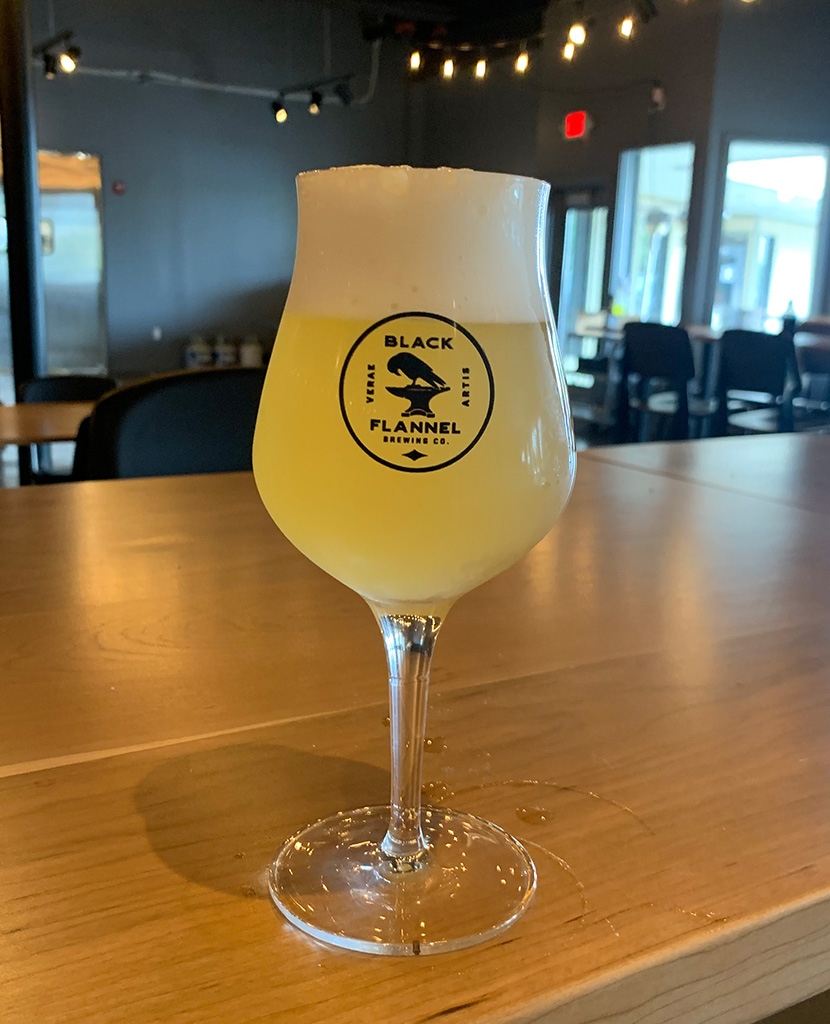
Now that it’s common for this beer to have lactic acidity, brewers approach how they achieve that acidity in a lot of different ways. Some traditional producers in Germany have a fairly complex process involving pitching ale yeast and lactobacillus into wort, blending, aging in oak, and then reblending before packaging (some American brewers do follow similar traditions, like August Schell in Minnesota). Other producers add brettanomyces strains to the fermentation either right away or after some aging for a lightly funky product. The most common American process involves what’s called kettle souring, which means that after the grain is mashed and run off, brewers add a lactic acid culture to the warm wort before boiling, then allow it to sit for up to 24-36 hours. This allows the bacteria culture to acidify the wort, which is then hopped and boiled at the lower pH (this is how Black Flannel produces its Berliner Weiss).
Finally, there are the syrups. Though it’s uncommon to see Berliner Weiss served this way in the states, when you order one of these in northern Germany, you’re likely to be offered an ounce or two of raspberry and woodruff syrup in the glass, which adds another layer of complexity to the beer, along with a very subtle additional sweetness. At Black Flannel, we make a slightly stronger (and slightly less acidic) than usual version of this style that we’re really proud of. If you stop by mid-summer, it’ll almost certainly be on our list along with house made syrups for you to try out the traditional serving style.
Modern Evolution
A regional specialty of Berlin; referred to by Napoleon’s troops in 1809 as “the Champagne of the North” due to its lively and elegant character. At one point, it was smoked and there used to be Marzen-strength (14 °P) version. Increasingly rare in German, but some American craft breweries now regularly produce the style.