Black Flannel Academy

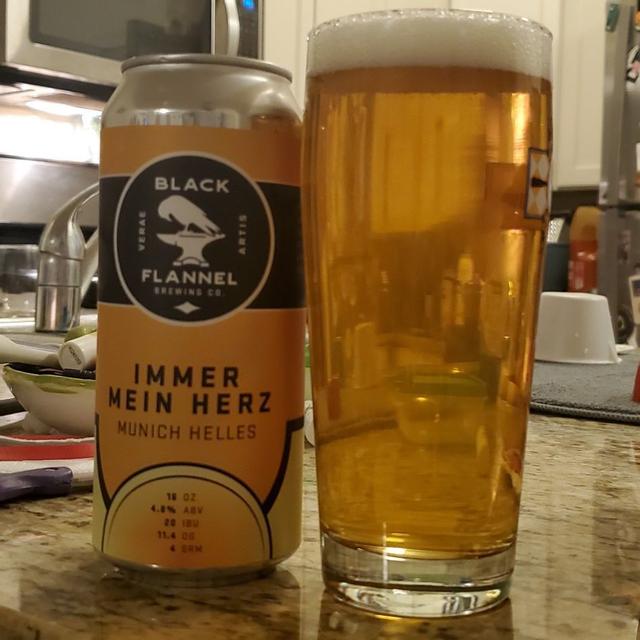
Munich Helles | Immer Mein Herz

bottom-fermented · central-europe · lagered · Malty · pale-color · pilsner-family · standard-strength · Traditional style

A clean, malty, gold-colored German lager with a smooth grainy-sweet malty flavor and a soft, dry finish. Subtle spicy, floral, or herbal hops and restrained bitterness help keep the balance malty but not sweet, which helps make this beer a refreshing, everyday drink.

Color

3 – 5 SRM

Bitterness

16 – 22 IBU

Alcohol

4.7 – 5.4% ABV

Sweetness

Balanced toward malt, but never sweet

Balance

Balanced toward malt, but never sweet

History

Historical Development

It's a bit embarrassing to admit it, but I recently shed tears of joy over how happy a beer made me (and not the "no you're my best friend" stumbly kind of tears). The crazy part was, it wasn't even a beer I was drinking…not exactly…

It was in the Augustiner Biergarten on Munich's west side, and my wife and I had just sat down with two liters of helles and a plate filled with more food than we would usually eat in a week (we ate it all). This was a moment I had been waiting for since we decided to make the pilgrimage to beer mecca the previous winter (though we were in Germany, so maybe that's biermecca?). There are a few places that every beer-lover should visit if they have the means-including Brussels, Plžen, and London among many others-but this was at the top of my list. We had spent the morning seeing the city, and when we finally sat down and took that first sip, it was a quiet revelation that couldn't be over (or under) stated. (That's not when the tears of joy came, but we'll get back to that.)

When most people get into craft beer, myself included, they search for the biggest, boldest, and most interesting new flavors you can find in a glass. Triple IPAs with ridiculous dry hopping, 15% stouts that spent more time in a barrel than some verbal children have on the earth, and, of course, any pint can with the words "New England" on it. For me, when I really started getting into beer and brewing, German lagers, and helles in particular, became the holy grail as a brewer. Its clean, crisp, malty, cracker-like profile is highlighted by notes (somehow) of white grapes and raw bread dough that are refined and delicate in a way that's tough to beat. What's even more interesting, these beers are one of the hardest you'll find to brew… with so little going into them, and so delicate a beer coming out, any subpar ingredient or small mistake in process can lead to an undrinkable beer.

As German beer styles go, the helles is one of the candidates for youngest of the bunch. Invented and released in 1894 by Spaten, it was meant to be a malty alternative to more bitter pilsners. Though it never gained quite the popularity worldwide that pilsners have, don't tell that to any Bavarians (you actually can…they love their helles enough to not give a damn). Since then, if you visit a beer garden that isn't at Theresienwiese in late September, chances are you'll see most of the people with a liter of helles. Though the story of this particular style isn't that old, when you have a few of them in a beer garden on a warm summer day, you can smell, taste, and feel the culture in that giant, beautiful glass. It tastes good, and by your second (or third) liter, you recognize the beauty in this beer: it's simple. It's there for you to enjoy the time you spend drinking it, and the people you're drinking it with.

The end of that opening story: an older man who was having a little trouble walking made his way up to the bar, got a liter of helles, and sat down on a bench he'd clearly sat in more than once over the years. He wasn't meeting anyone, but had genuine joy on his face as he looked around at the beautiful day, raised his maß away from himself just a bit, then drank a quarter of it all at once. Moments like this can remind you that beer, no matter the style, means a lot more to people than just any old drink. Sometimes it's your culture and memories poured in a mug.

Prost to that.

Modern Evolution

Created in Munich in 1894 at the Spaten brewery to compete with pale Pilsner-type beers. Currently the most popular style in Southern Germany.

Classic characteristics

Appearance

Pale

Aroma

Crisp, crackery malt

Light kiss of German noble hops

Flavor

Balanced toward malt, but never sweet

Mouthfeel

Dry, light body with crisp finish

Flavor Profile Deep Dive

Service notes

BJCP designation

Overall Impression: A clean, malty, gold-colored German lager with a smooth grainy-sweet malty flavor and a soft, dry finish. Subtle spicy, floral, or herbal hops and restrained bitterness help keep the balance malty but not sweet, which helps make this beer a refreshing, everyday drink.

Aroma: Moderate grainy-sweet malt aroma. Low to moderately-low spicy, floral, or herbal hop aroma. While a clean aroma is most desirable, a very low background note of DMS is not a fault. Pleasant, clean fermentation profile, with malt dominating the balance. The freshest examples will have more of a malty-sweet aroma.

Appearance: Medium yellow to pale gold. Clear. Persistent creamy white head.

Flavor: Moderately malty start with the suggestion of sweetness, moderate grainy-sweet malt flavor with a soft, rounded palate impression, supported by a low to medium-low hop bitterness. The finish is soft and dry, not crisp and biting. Low to moderately-low spicy, floral or herbal hop flavor. The malt dominates the hops in the palate, finish, and aftertaste, but the hops should be noticeable. There should not be any residual sweetness, simply the impression of maltiness with restrained bitterness. Very fresh examples will seem sweeter due to the fresh, rich malt character that can fade with time. Clean fermentation profile.

Mouthfeel: Medium body. Medium carbonation. Smooth, well-lagered character.

Comments: A fully-attenuated Pils malt showcase, Helles is a malt-accentuated beer that is not overly sweet, but rather focuses on malt flavor with underlying hop bitterness in a supporting role. Export examples can quickly lose some of the rich malt character that often suggests sweetness. Helles in Munich tends to be lighter in all aspects than those outside the city, which can be more assertive with more body, flavor, and hop character.

History: Created in Munich in 1894 at the Spaten brewery to compete with pale Pilsner-type beers. Currently the most popular style in Southern Germany.

Characteristic Ingredients: Continental Pilsner malt, traditional German Saazer-type hop varieties, clean German lager yeast.

Style Comparison: Similar in malt balance and bitterness to Munich Dunkel, but less malty-sweet in nature and pale rather than dark. More body and malt presence than a German Pils, with less hop character throughout. Similar malt profile as a German Exportbier, but with less hops in the balance.

Vital Statistics: OG: 1.044 – 1.048 IBUs: 16 – 22 FG: 1.006 – 1.012 SRM: 3 – 5 ABV: 4.7 – 5.4%

Commercial Examples: Augustiner Lagerbier Hell, Burgerbrau Wolznacher Hell Naturtrub, Hacker-Pschorr Munchner Gold, Lowenbrau Original, Paulaner Premium Lager, Spaten Premium Lager, Weihenstephaner Original

Brewers Association designation

  • Munich-Style Helles
    • Color: Pale to golden
    • Clarity: Appearance should be clear. Chill haze should not be present
    • Perceived Malt Aroma & Flavor: Malt aroma and flavor are pronounced. Low levels of yeast-produced sulfur aromas and flavors may be present. Malt character is sometimes bready and suggestive of lightly toasted malted barley. There should be no caramel character.
    • Perceived Hop Aroma & Flavor: Hop aroma is not present to low. Hop flavor is very low to low, derived from noble-type hops.
    • Perceived Bitterness: Low, derived from European noble-type hops.
    • Fermentation Characteristics: Fruity esters, DMS and diacetyl should not be present. A very low level of sulfur attributes may be present in balance with other attributes.
    • Body: Medium
    • Additional notes: Many beer brands known as Austrian-Style Maerzen are nearly indistinguishable from Munich-Style Helles and are appropriately categorized here.
  • Original Gravity (°Plato) 1.044-1.050(11-12.4 °Plato) – Apparent Extract/Final Gravity (°Plato) 1.008-1.012(2.1-3.1 °Plato) – Alcohol by Weight (Volume) 3.8%-4.4%(4.8%-5.6%) – Bitterness (IBU) 18-25 – Color SRM (EBC) 4-5.5(8-11 EBC)

Style comparison

Parent Categories

Similar in malt balance and bitterness to Munich Dunkel, but less malty-sweet in nature and pale rather than dark. More body and malt presence than a German Pils, with less hop character throughout. Similar malt profile as a German Exportbier, but with less hops in the balance.

Similar Styles from Other Classifications

Ingredients

Grain Bill

  • Traditionally made only with German pilsner malt
  • Light use of German hops
  • German lager yeast

Brewing process

Mash Profile

Decoction brewing is a hallmark of traditional helles. Instead of mixing hot water with malt and then letting it rest at a single temperature, brewers begin the mash at lower temperatures, then pull a portion of the mash and boil it (see this post on why we decoct for more info on this). The boiled portion is then added back to the main mash, and the whole process is repeated twice before the wort is drained into the kettle and boiled with hops. The finished wort is chilled and fermented cool with a lager yeast, then held at lagering temperature (usually around 32F) for several weeks to clarify, soften, and round the flavors together.

Food pairings

At the pub: Pretzel with pub mustard

Also at the pub: Smash Burger with Thrice Cooked Chips

At a biergarten: Sausages, mustard, and kraut

Desserts

Spirit pairings

Cognac

Gin (barrel-aged too!)

The soundtrack

New: Bela Fleck and Abigail Washburn

Old: Bach, Cello Suite No. 1 in G Major

Keep exploring

Commercial Examples

Augustiner Lagerbier Hell, Black Flannel Brewing Immer Mein Herz, Burgerbrau Wolznacher Hell Naturtrub, Hacker-Pschorr Munchner Gold, Lowenbrau Original, Paulaner Premium Lager, Spaten Premium Lager, Weihenstephaner Original

International Breweries

Beer Cocktail Recipe

"Louisville Boilermaker"

Ingredients:

12 oz Munich Helles

1.5 oz. of bourbon or rye whiskey

Lemon/Lime Soda: 7-up, Sprite, or Sparkling Ice Lemon Lime

Lemon (garnish)

Directions:

In a pint glass, pour beer at an angle to eliminate head. Add 1.5 oz. of bourbon or rye. Top with Lemon/Lime Soda. Garnish with lemon wedge.

Return to all beer styles

Scroll to Top