
Commercial Examples
Aldaris Porteris, Baltika #6 Porter, Devils Backbone Danzig, Okocim Porter, Sinebrychoff Porter, Zywiec Porter

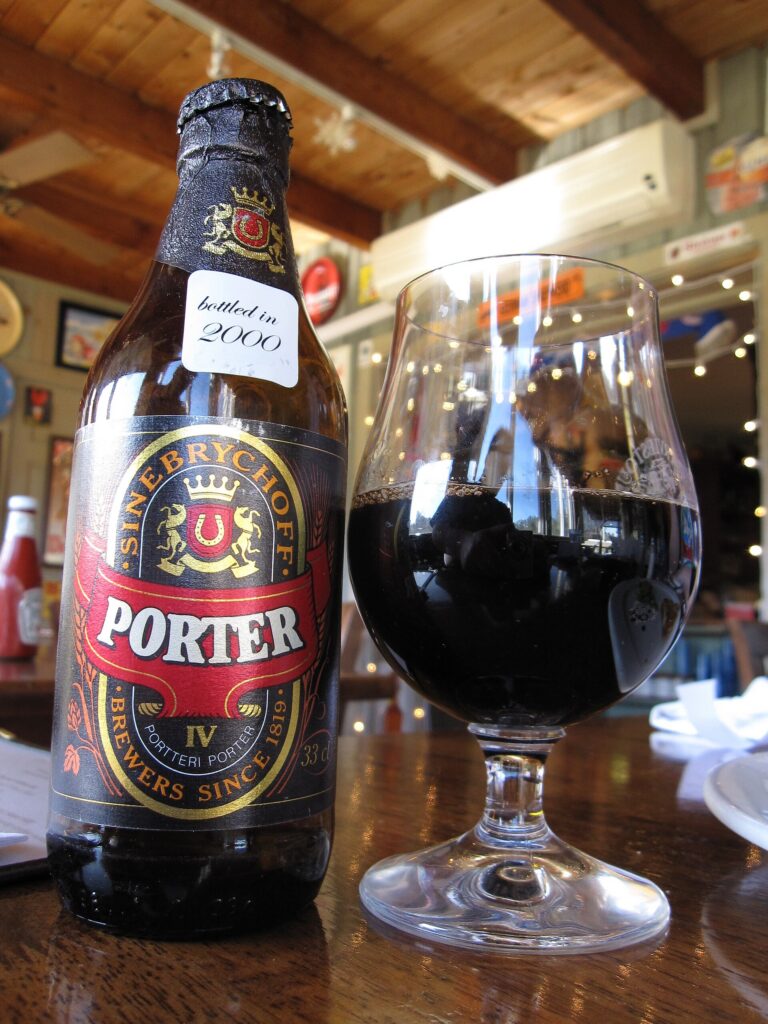
A Baltic Porter often has the malt flavors reminiscent of an English porter and the restrained roast of a schwarzbier, but with a higher OG and alcohol content than either. Very complex, with multi-layered malt and dark fruit flavors.
Like every beer with "porter" or "stout" in its name, the dark beers of early eighteenth-century London inspired this style, which has evolved considerably since that time. The details on who first sent a strong porter to Russia are murky, but by the end of the 1700s, there were at least a dozen brewers sending their versions through the Baltic countries to Russia. Much of this stock also made it to Sweden, Finland, Latvia, and Lithuania, where it was equally popular.
Unfortunately, for much of recent history the word "lager" has been synonymous with "bland carbonated corn water" in the United States. We'll tackle a short history of the real difference between "ale" and "lager" in another post, but what's important for us here is that even the cleanest of ale yeasts produces considerably more fruity esters and spicy phenols than lager yeasts. This is an especially important distinction in this style's history, because when brewers in the Baltic region first tried their hands at making strong porters, they would have been based on the beer coming out of London, and therefore brewed with ale yeast. In today's terms, those early beers would be a closer relative to today's Russian Imperial Stouts than modern Baltic Porters. As lager took hold of the world in the 1800s, however, brewers in the Baltics slowly adopted saccharomyces pastorianus strains for all of their beer, brewing these heavier porters with that yeast as well. What resulted after decades of stylistic drift was a rich, malty, dark, and highly alcoholic beer that had all of the malt character of an imperial stout without the fruity yeast components.
Baltic porter is special in that it allows the malt to shine through as the star of the flavor show. Don't get us wrong, we LOVE imperial stouts, and they're definitely the king (empress?) when it comes to big, aggressive flavor in dark beers. The Baltic porter is an elegant twist on the assertiveness of imperial stout…it's a bit softer, focusing on fragrant chocolate, malty dark fruit, and deeply toasted bread. You won't find much hop aroma in these either, leaving the malt front and center.
While they're certainly becoming more popular in recent years, Baltic porters still don't enjoy the attention that imperial stouts do. If you can find one of them, crack it open on a cold winter evening and share it with a loved one by the fire for dessert. If not, bring your loved one to the brewpub on that cold night…we've got a nice warm fireplace and a Baltic porter we're in love with.
Traditional beer from countries bordering the Baltic Sea, developed indigenously after higher-gravity export brown or imperial stouts from England were established. Historically top-fermented, many breweries adapted the recipes for bottom-fermenting yeast along with the rest of their production. Characteristic Ingredients: Generally lager yeast (cold fermented if using ale yeast, as is required when brewed in Russia). Debittered chocolate or black malt. Munich or Vienna base malt. Continental hops (Saazer-type, typically). May contain crystal malts and/or adjuncts. Brown or amber malt common in historical recipes.
Brown through opaque black
Deep maltiness featuring toast, dark fruit, and chocolate
Sweet sensation from substantial malt
Very little perceived bitterness
Full body
Smooth, long, malty and warm finish
Overall Impression: A Baltic Porter often has the malt flavors reminiscent of an English porter and the restrained roast of a schwarzbier, but with a higher OG and alcohol content than either. Very complex, with multi-layered malt and dark fruit flavors.
Aroma: Rich malty sweetness often containing caramel, toffee, nutty to deep toast, and/or licorice notes. Complex alcohol and ester profile of moderate strength, and reminiscent of plums, prunes, raisins, cherries or currants, occasionally with a vinous Port-like quality. Some darker malt character that is deep chocolate, coffee or molasses but never burnt. No hops. No sourness. Very smooth.
Appearance: Dark reddish-copper to opaque dark brown (not black). Thick, persistent tan-colored head. Clear, although darker versions can be opaque.
Flavor: As with aroma, has a rich malty sweetness with a complex blend of deep malt, dried fruit esters, and alcohol. Has a prominent yet smooth schwarzbier-like roasted flavor that stops short of burnt. Mouth-filling and very smooth. Clean lager character. Starts sweet but darker malt flavors quickly dominates and persists through finish. Just a touch dry with a hint of roast coffee or licorice in the finish. Malt can have a caramel, toffee, nutty, molasses and/or licorice complexity. Light hints of black currant and dark fruits. Medium-low to medium bitterness from malt and hops, just to provide balance. Hop flavor from slightly spicy hops ranges from none to medium-low.
Mouthfeel: Generally quite full-bodied and smooth, with a well-aged alcohol warmth. Medium to medium-high carbonation, making it seem even more mouth-filling. Not heavy on the tongue due to carbonation level.
Comments: May also be described today as an Imperial Porter, although heavily roasted or hopped versions are not appropriate for this style. Most versions are in the 7-8.5% ABV range. Danish breweries often refer to them as Stouts, which indicates their historic lineage from the days when Porter was used as a generic name for Porter and Stout.
History: Traditional beer from countries bordering the Baltic Sea, developed indigenously after higher-gravity export brown or imperial stouts from England were established. Historically top-fermented, many breweries adapted the recipes for bottom-fermenting yeast along with the rest of their production. Characteristic Ingredients: Generally lager yeast (cold fermented if using ale yeast, as is required when brewed in Russia). Debittered chocolate or black malt. Munich or Vienna base malt. Continental hops (Saazer-type, typically). May contain crystal malts and/or adjuncts. Brown or amber malt common in historical recipes.
Style Comparison: Much less roasted and smoother than an Imperial Stout, typically with less alcohol. Lacks the roasty qualities of stouts in general, more taking on the roasted-but-not-burnt characteristics of a schwarzbier. Quite fruity compared to other porters. Higher alcohol than other porters.
Vital Statistics: OG: 1.060 – 1.090
IBUs: 20 – 40
FG: 1.016 – 1.024
SRM: 17 – 30
ABV: 6.5 – 9.5%
Commercial Examples: Aldaris Porteris, Baltika #6 Porter, Devils Backbone Danzig, Okocim Porter, Sinebrychoff Porter, Zywiec Porter
Much less roasted and smoother than an Imperial Stout, typically with less alcohol. Lacks the roasty qualities of stouts in general, more taking on the roasted-but-not-burnt characteristics of a schwarzbier. Quite fruity compared to other porters. Higher alcohol than other porters.
Two-row brewers malt
Caramel malts of various colors
Roasted malts, particularly dehusked variety
Light hopping with traditional European varieties
Lager yeast
Age
Single infusion mash in the mid to upper saccharification temperature range for a full finish. Ferment cool–no more than 50F–for a smooth, clean profile. Lager for at least three months, the longer the better. This beer really needs some age to find its best characters, so plan to brew it early enough in the season to have it around for December-February.
At the Pub: Scotch Egg
Takeout: Barbeque
Casual date: Dessert date night…anything will do!
Wheated bourbon with some time in the barrel
New: Brian Eno – Ambient 1
Old: Arvo Part
Aldaris Porteris, Baltika #6 Porter, Devils Backbone Danzig, Okocim Porter, Sinebrychoff Porter, Zywiec Porter